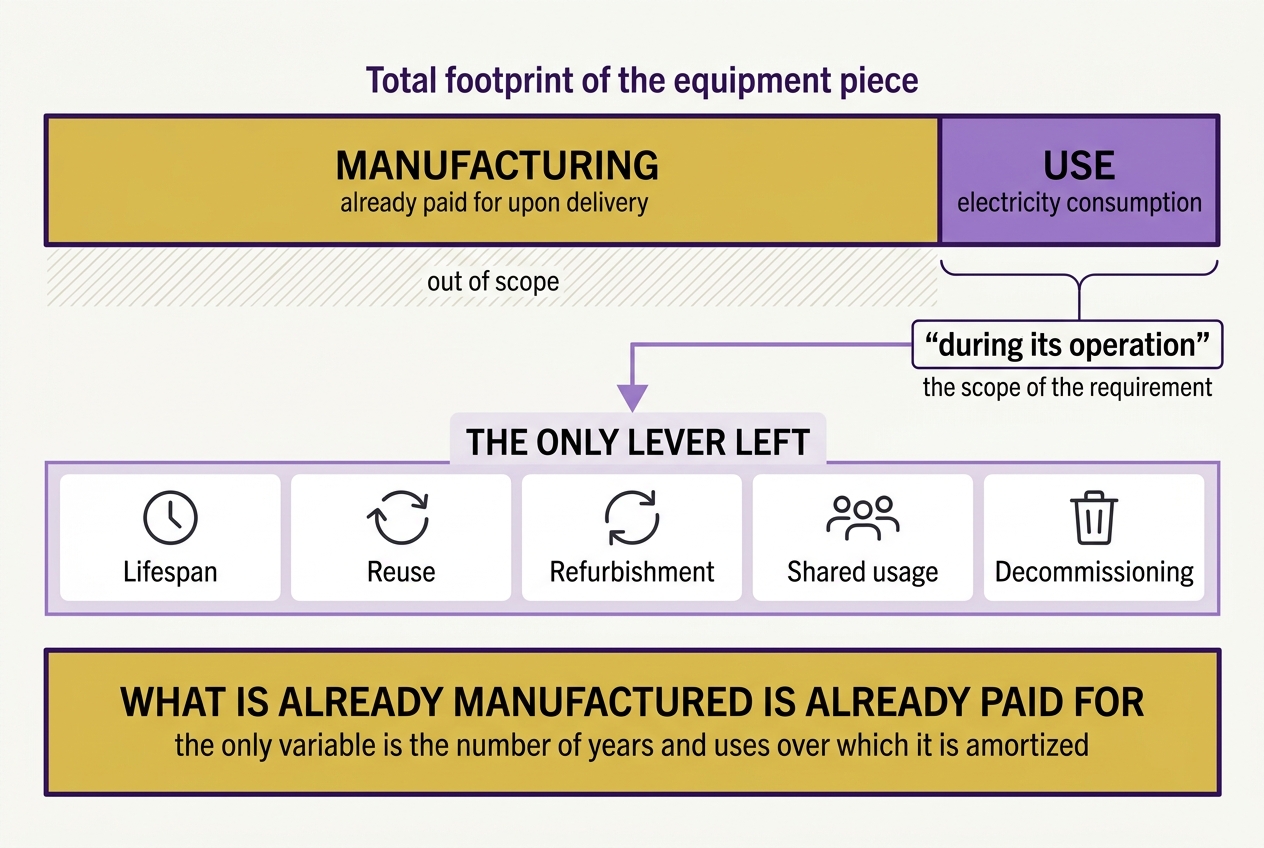
Bar showing the footprint of a device, split into a large manufacturing segment and a small usage segment; the requirement covers only the usage segment, while five levers — lifespan, reuse, refurbishment, pooling, decommissioning — apply to the manufacturing segment

What is already manufactured is already paid for

Green IT series — Article 4/4 Two years ago, as part of a CSRD compliance programme, I was handed a non-functional requirement. It came down to a single sentence: the solution must make it possible to have indicators for assessing its environmental impact during operation. An environmental requirement, written in black and white, in a document that binds design. On paper, that is a win. In short Three words are enough to empty an environmental requirement of its force: during operation excludes manufacturing, which is to say the heaviest item of all. What is already manufactured is already paid for. The only remaining variable is lifespan, reuse and decommissioning — which is where the circular economy of IT becomes an architecture subject. Regulatory pressure has receded; the footprint has not. An organisation that has not prepared the ground will find itself at exactly the same point when the demand returns. ⎙ Imprimer / Télécharger en PDF Three words that empty a requirement Let us read it again, because everything turns on how it is worded. ...
September 17, 2026 · 11 min · Laurence Poussard
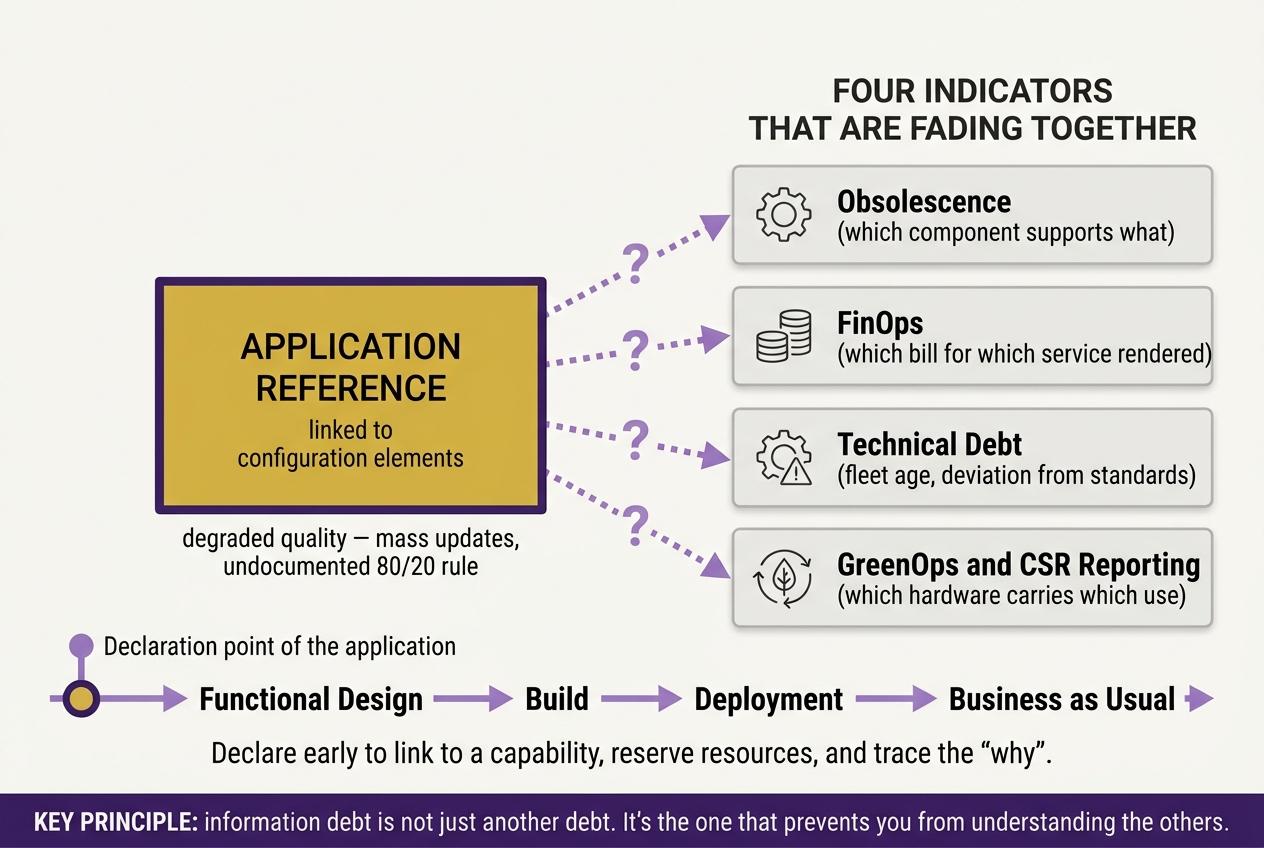
The application reference linked to configuration elements, and the four indicators — obsolescence, FinOps, technical debt, GreenOps and CSR reporting — that fade together when it degrades

Technical debt is carbon debt

Green IT series — Article 2/4 One day, an IT department is asked to measure the carbon footprint of its application portfolio. The request is legitimate, the sponsor is solid, the deadline is regulatory. And that is when it emerges that the number is out of reach. Not because the method is missing — because the data it would have to be applied to was bulk-updated some years ago, according to a rule nobody remembers the content of. ...

September 7, 2026 · 13 min · Laurence Poussard
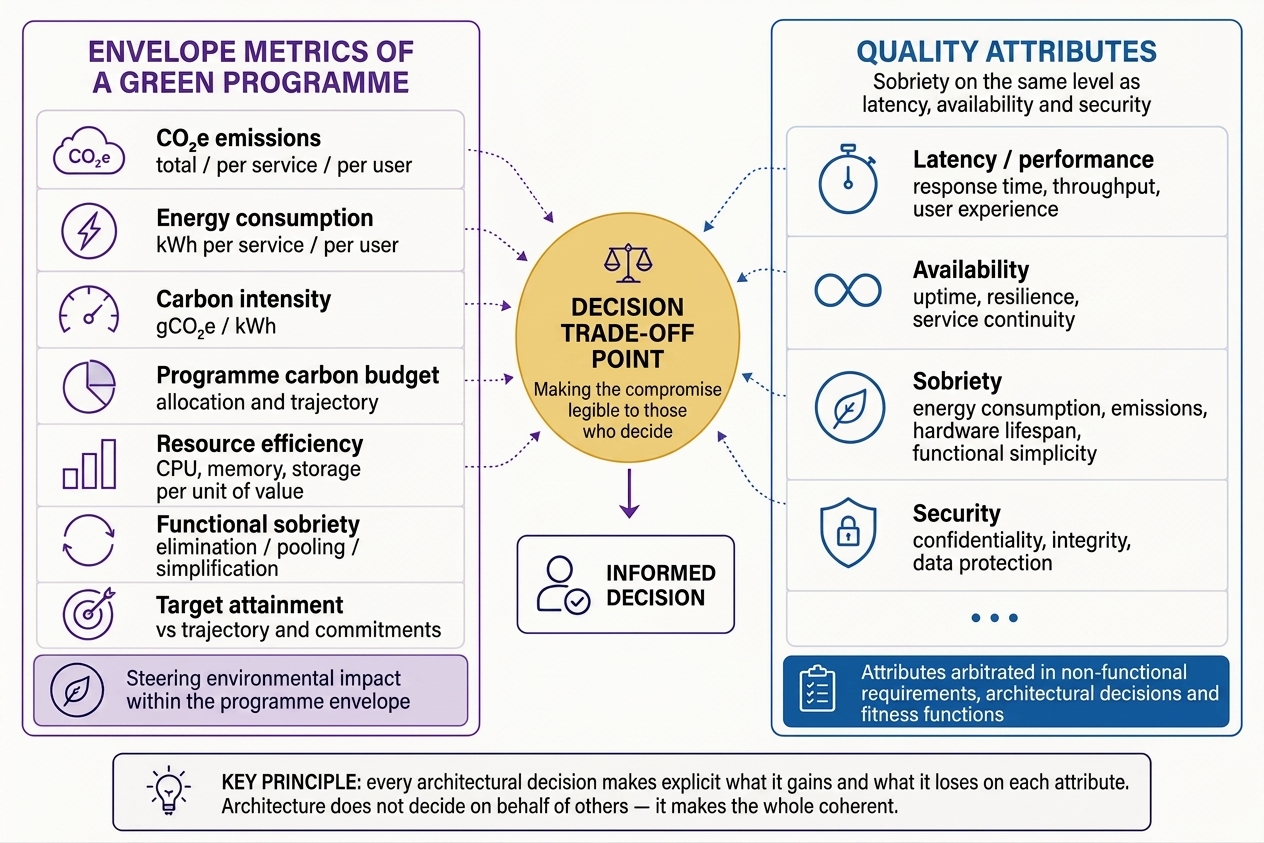
Two-column diagram: on the left the envelope metrics of a green programme, on the right quality attributes including sobriety alongside latency, availability and security; at the centre a decision trade-off point connecting both and leading to an informed decision

Everyone optimises, no one arbitrates

Green IT series — Article 1/4 A perfectly cooled datacentre, running workloads no one consults any more, will post an excellent PUE. That is the whole problem. And it is only the visible version of a much wider paradox. In short PUE measures the efficiency of the envelope, never the usefulness of the computation — and the same illusion plays out at organisational scale, where a green programme coexists with projects that have no reason to ever cross its path. Enterprise architecture is not there to constrain choices or arbitrate between visions. It is there to make the whole coherent — provided it sits in the right place, with the right levers. Sobriety and the circular economy of IT are not programmes running alongside the value stream. They are quality attributes within the value stream. ⎙ Imprimer / Télécharger en PDF A flawless indicator for an absurd system Let us start with the tool, since the tool is what gets brandished. ...

September 4, 2026 · 14 min · Laurence Poussard

What you build does not belong to you

A short journey through the floors of an organisation that pays a lot to move slowly — and everything it would gain by doing things differently In short An information system’s dysfunctions are not primarily technical but organisational: what you build does not belong to you, it belongs to the collective. Without a clear, shared framework, AI fixes nothing: it industrialises the disorder instead of resolving it. Working within a clear framework is not a loss of autonomy — it is a gain in energy. ⎙ Imprimer / Télécharger en PDF In 80% of cases, IT is not the company’s business. It is a means. A means serving a retailer, a manufacturer, a laboratory, an energy company. Yet this means consumes a great deal, delivers slowly, and sometimes ends up holding back the very ambitions it was meant to serve. ...

May 6, 2026 · 8 min · Laurence Poussard

The enterprise architect, strategist of the real — not a builder of IT systems

In short Geopolitics has become an architecture variable in its own right: choosing a cloud or a model is a bet on the stability of the world. The urban-planner architect draws maps; the strategic architect travels from the executive committee to the field and translates the world into concrete constraints. In a world that reshapes itself faster than any map, value comes from the continuous loop — capture, translate, structure, learn. ⎙ Imprimer / Télécharger en PDF There is one question few organisations ask before the answer becomes urgent: what does our information system actually depend on? Not what it does. What it depends on. The undersea cables that carry 97% of global internet traffic. The American hyperscalers whose servers fall under the Cloud Act. The Taiwanese chips without which no infrastructure gets renewed. The SaaS vendors headquartered in San Francisco with their data in Dublin — in a jurisdiction that answers to Washington. ...

March 15, 2026 · 5 min · Laurence Poussard