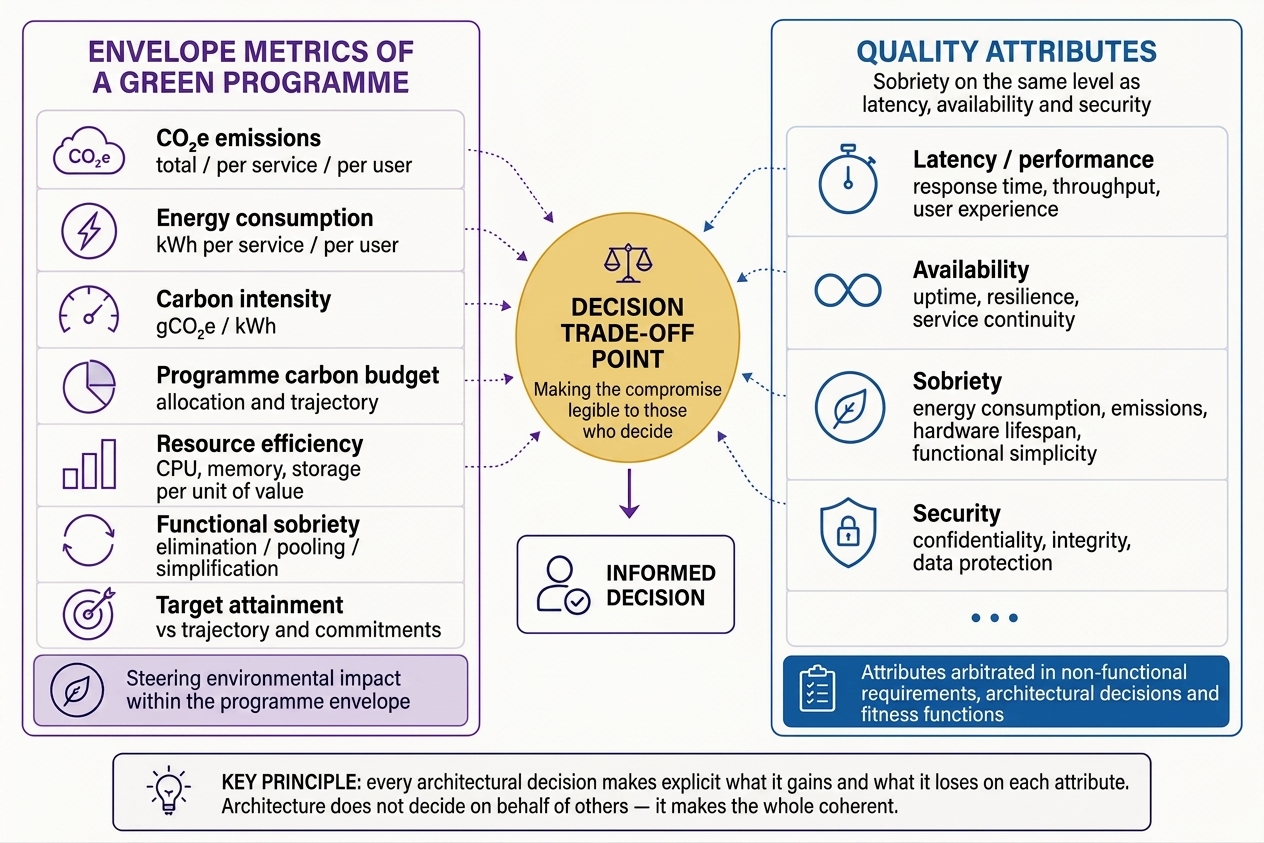
Two-column diagram: on the left the envelope metrics of a green programme, on the right quality attributes including sobriety alongside latency, availability and security; at the centre a decision trade-off point connecting both and leading to an informed decision

Everyone optimises, no one arbitrates

Green IT series — Article 1/4 A perfectly cooled datacentre, running workloads no one consults any more, will post an excellent PUE. That is the whole problem. And it is only the visible version of a much wider paradox. In short PUE measures the efficiency of the envelope, never the usefulness of the computation — and the same illusion plays out at organisational scale, where a green programme coexists with projects that have no reason to ever cross its path. Enterprise architecture is not there to constrain choices or arbitrate between visions. It is there to make the whole coherent — provided it sits in the right place, with the right levers. Sobriety and the circular economy of IT are not programmes running alongside the value stream. They are quality attributes within the value stream. ⎙ Imprimer / Télécharger en PDF A flawless indicator for an absurd system Let us start with the tool, since the tool is what gets brandished. ...

September 4, 2026 · 14 min · Laurence Poussard
A circuit-board key in front of the shadow of a fragmented information system, made of servers, databases and legacy code

Conway's Law: When HR Titles Fragment the System Before the Code Does

In short Jack of all trades, master of none: that hire has never delivered Architecture gets decided the moment the org chart and job descriptions are written In the age of AI, the mistake costs more: the real scarcity isn’t model mastery, it’s knowledge of the business being assisted ⎙ Imprimer / Télécharger en PDF Cloud architect. AI architect. DevOps architect. Integration architect. Tomorrow, no doubt, agentic architect. Every technology wave demands its own totem, and the organization complies — a role, a job description, a line in the org chart. ...

July 31, 2026 · 10 min · Laurence Poussard

Value is at the interfaces, not in the tech

Decision Day 2026 series — Article 3/3 In short It isn’t AI that creates value: it reveals the badly governed borders between the organisation’s silos. Conway’s law: failing technical interfaces are the mirror of broken communication between departments. That leaves the question no one asks: who has the mandate to govern those borders? A strategic architect. ⎙ Imprimer / Télécharger en PDF There is a sentence that Vincent Luciani, co-founder of Artefact, laid down with disarming simplicity at Decision Day 2026: ...

June 24, 2026 · 8 min · Laurence Poussard

The enterprise architect, strategist of the real — not a builder of IT systems

In short Geopolitics has become an architecture variable in its own right: choosing a cloud or a model is a bet on the stability of the world. The urban-planner architect draws maps; the strategic architect travels from the executive committee to the field and translates the world into concrete constraints. In a world that reshapes itself faster than any map, value comes from the continuous loop — capture, translate, structure, learn. ⎙ Imprimer / Télécharger en PDF There is one question few organisations ask before the answer becomes urgent: what does our information system actually depend on? Not what it does. What it depends on. The undersea cables that carry 97% of global internet traffic. The American hyperscalers whose servers fall under the Cloud Act. The Taiwanese chips without which no infrastructure gets renewed. The SaaS vendors headquartered in San Francisco with their data in Dublin — in a jurisdiction that answers to Washington. ...

March 15, 2026 · 5 min · Laurence Poussard