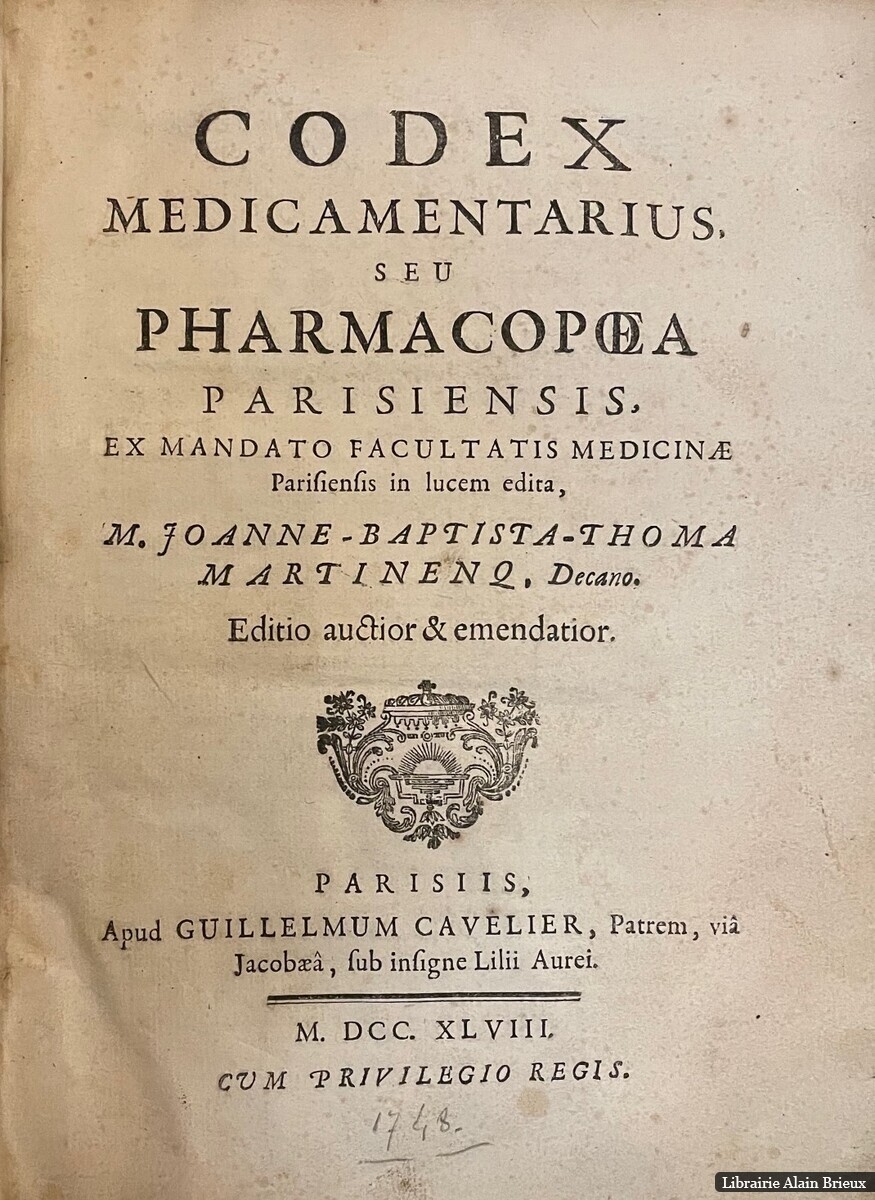
Title page of the Codex Medicamentarius seu Pharmacopœa Parisiensis (1748), the old official pharmacopoeia of Paris

Cure and poison: AI dosage is an architecture decision

One sentence, heard this morning in a podcast recorded in June at VivaTech. Aldrick Zappellini, Chief Data Officer of the Crédit Agricole group, was talking about cybersecurity and described AI as “typically a cure, but also a poison” (my translation). I will not dissect the interview: it deserves to be heard in full, and everyone will draw their own reading from it. I simply want to start from that word, because it says far more than it seems. Provided we take it seriously, and do not turn it into a learned synonym for “double-edged sword”. ...

October 15, 2026 · 9 min · Laurence Poussard
A woman sitting cross-legged on a terrace facing mountains at sunset, a notebook and a cup beside her, in conversation with a luminous figure representing AI

What if AI gave the mind back to what matters?

It wasn’t at a conference on AI that I heard the truest sentence about AI in recent weeks. It was on a podcast about rest, listening to a coach talk about ten days on retreat in the Jura mountains. She wasn’t talking about models, or productivity, or transformation. She was talking about everything that doing nothing gives us: rest, silence, the ideas that surface when the mind is finally allowed to settle. And along the way, in two sentences, she said what I’ve been defending for a long time about the place of AI. ...

September 26, 2026 · 16 min · Laurence Poussard
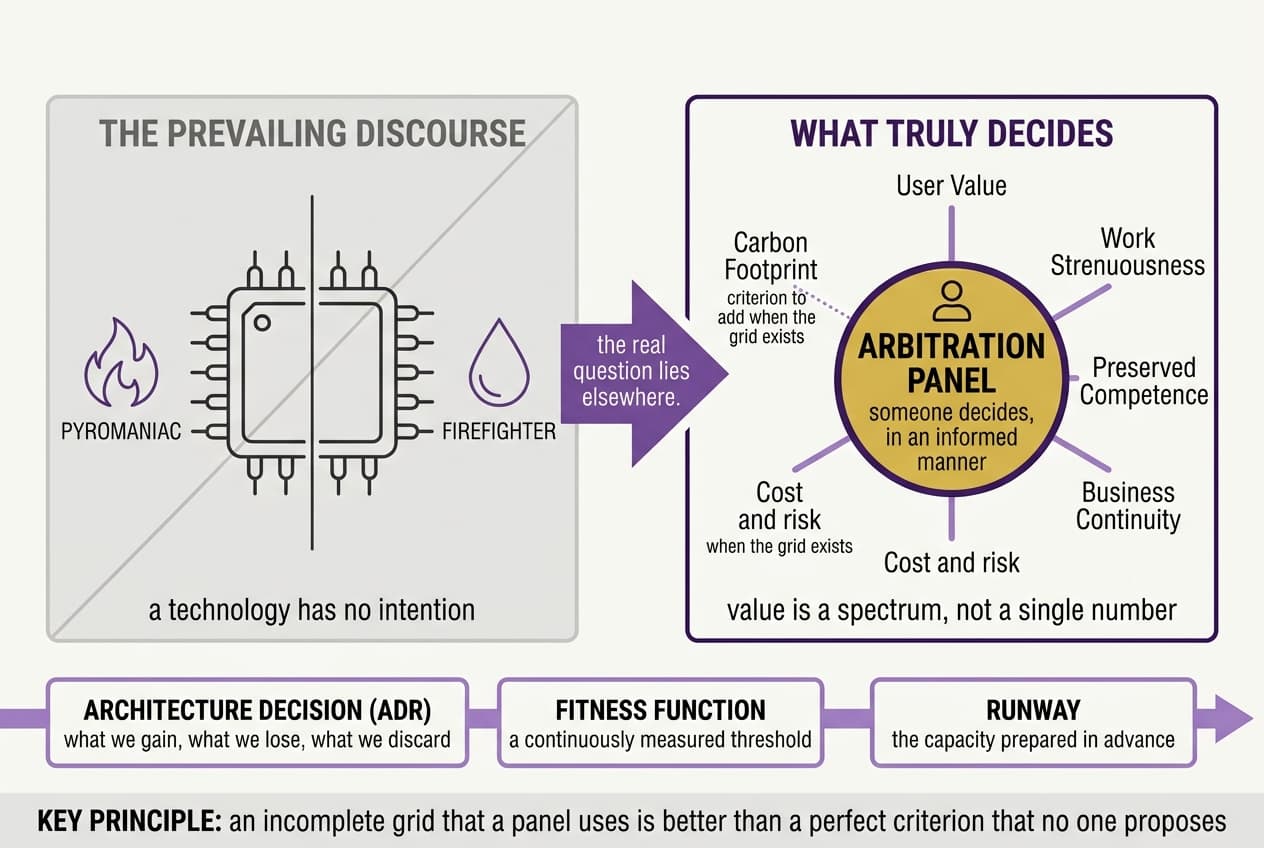
Diagram contrasting the ambient narrative of AI as firefighter and arsonist, set aside, with a decision arbitration body surrounded by several axes of value including a dotted carbon axis, above a band showing architecture decision records, fitness functions and runways

AI is not the arsonist

Green IT series — Article 3/4 I have a weather station at home. It gives me temperature, pressure, humidity and the variations of the last few hours. With that, I have a fair idea of tomorrow’s weather — and if I am unsure, a dozen outlets publish the forecast for free. And yet the question of tomorrow’s weather is put to generative AI thousands of times a day. Systems which must analyse everything before answering. ...

September 9, 2026 · 15 min · Laurence Poussard
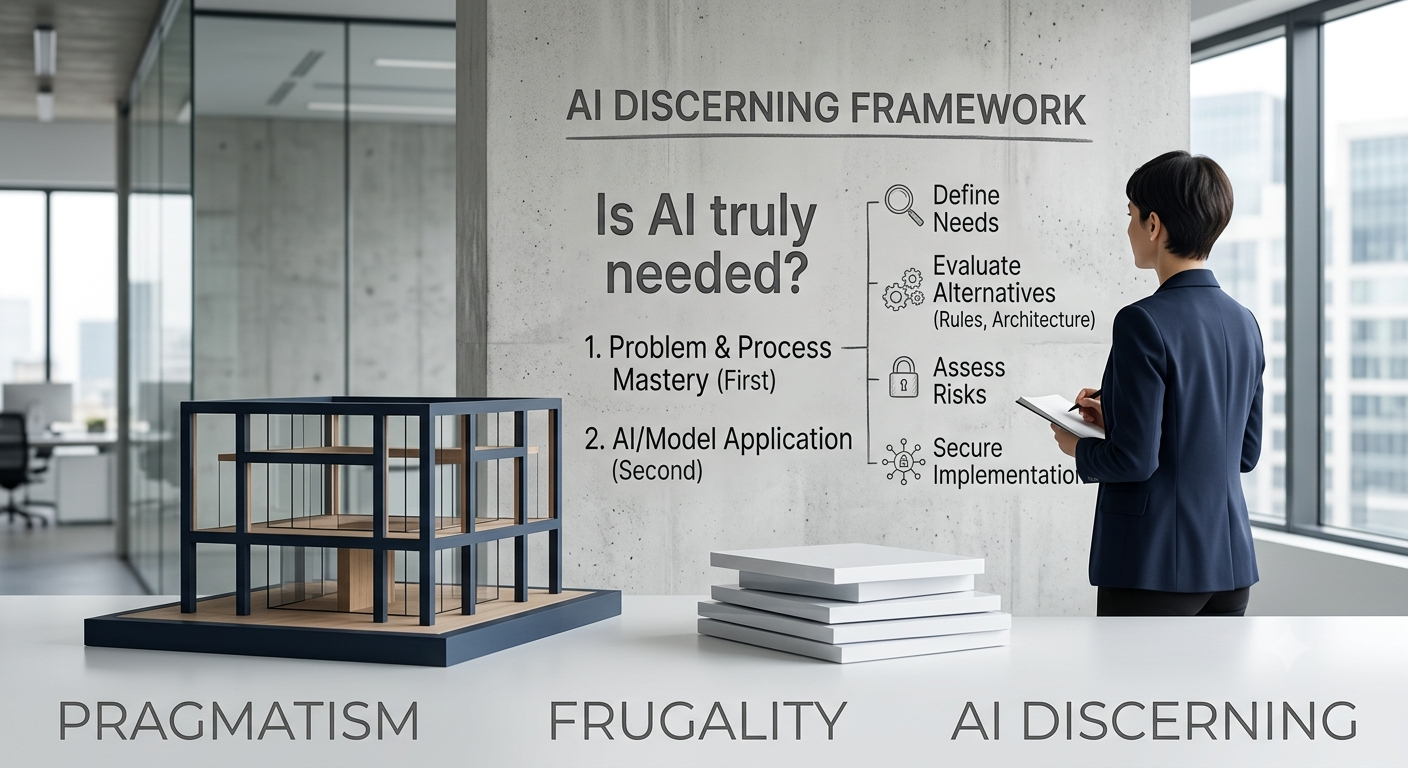
An architecture model next to a diagram titled AI Discerning Framework, with the words pragmatism, frugality and AI discerning

AI Maximalism Is Not a Sign of Boldness

In short Pushing AI to its limits is not a sign of audacity: it is often a lack of judgment disguised as courage. True audacity lies in deliberate frugality—choosing where AI creates value, and where it does not. Pragmatism is not lukewarmness: it is the most demanding form of technological discernment. ⎙ Imprimer / Télécharger en PDF There’s a reflex I see resurface in almost every engagement I work on, in different guises but with the same root: the conviction that AI is needed, everywhere, right now, or you’ll fall behind. This reflex has a name, and I won’t shy away from it: it’s maximalism. And like every form of maximalism, it dresses itself up as strategic necessity to dodge the only question that matters: do we actually need this? ...

July 27, 2026 · 7 min · Laurence Poussard
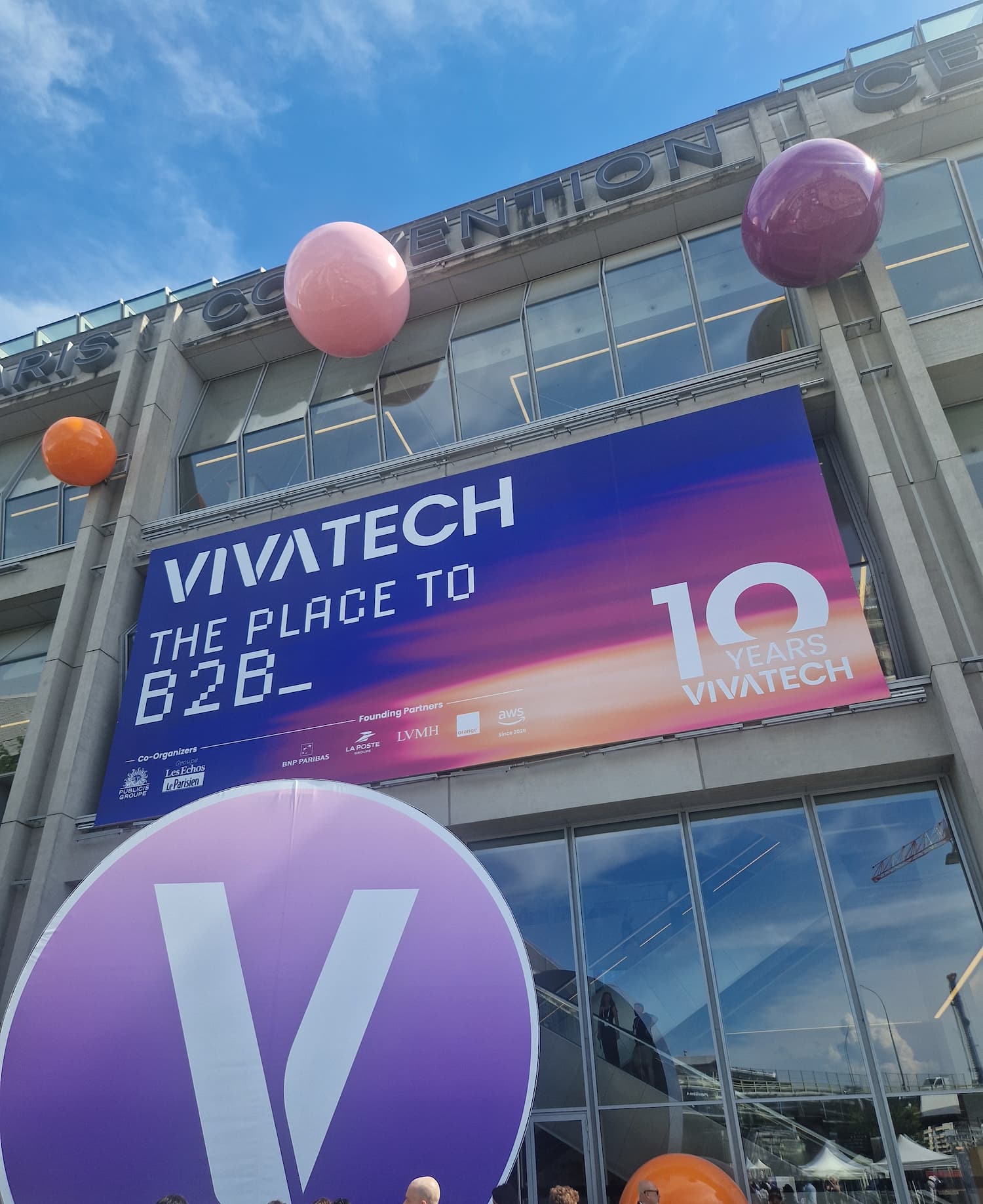
Vivatech - 10th edition - 2026

VivaTech 2026: what I saw struck me less than what it revealed

Yes, VivaTech was ten days ago. No, I didn’t write in the heat of the moment. Everyone else did. The LinkedIn posts went up on Thursday evening — rocket emojis, selfies with robots, “game changer,” “mind blown,” and the traditional blurry photo of a screen displaying something impressive. I chose not to do that. Not out of snobbery. Out of intellectual honesty. Because a show like VivaTech is designed to dazzle you. That’s its function. It’s even its virtue — it makes visible what is still invisible in most organizations. But between what you see and what it means, there is work to be done. Work of distillation, of putting things in tension, of connecting what you observe with what you see elsewhere, in the organizations you support. ...

June 30, 2026 · 7 min · Laurence Poussard

Value is at the interfaces, not in the tech

Decision Day 2026 series — Article 3/3 In short It isn’t AI that creates value: it reveals the badly governed borders between the organisation’s silos. Conway’s law: failing technical interfaces are the mirror of broken communication between departments. That leaves the question no one asks: who has the mandate to govern those borders? A strategic architect. ⎙ Imprimer / Télécharger en PDF There is a sentence that Vincent Luciani, co-founder of Artefact, laid down with disarming simplicity at Decision Day 2026: ...

June 24, 2026 · 8 min · Laurence Poussard

What AI does to our brain

Decision Day 2026 series — Article 2/3 In short We govern the data we give to AI; no one governs what AI does to the capacity to think of those who consult it. A neural network that is no longer used atrophies: cognitive dependency is the most durable and the hardest to reverse. Cognitive sovereignty — preserving a trained human judgement — becomes a governance question in its own right. ⎙ Imprimer / Télécharger en PDF We talk a great deal about data sovereignty. We’re beginning to talk about energy sovereignty and model sovereignty. We almost never talk about cognitive sovereignty. ...

June 17, 2026 · 8 min · Laurence Poussard
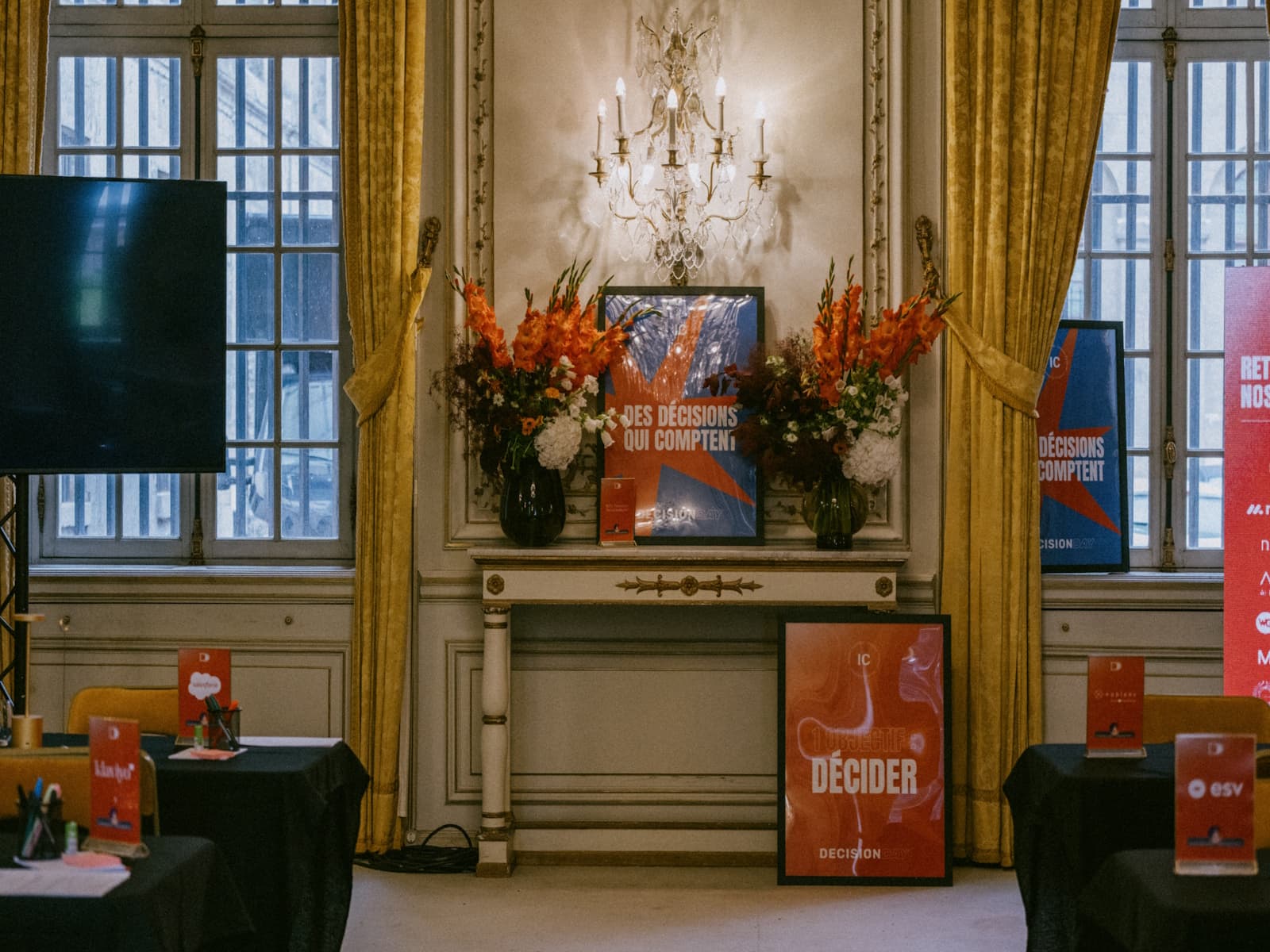
Decision Day 2026 — War Room workshop on the governance of AI decisions

Before deploying AI, have you mapped your decisions?

Decision Day 2026 series — Article 1/3 In short Before choosing a model or a budget, the real question is: which decisions do we delegate, to whom, and with what possibility of taking back control? Three levels structure governance: full delegation, co-decision, exclusion. Mapping your decisions is the prerequisite no one wants to fund — without it, AI amplifies the existing disorder. ⎙ Imprimer / Télécharger en PDF There is a question almost no organisation asks before launching its AI programme. ...

June 5, 2026 · 7 min · Laurence Poussard

When AI plays at scaring itself — and at making us believe

In short AI doomerism has the structure of a religious movement — but what matters isn’t the discourse, it’s the capture it performs. The very actors brandishing existential risk are building the AI and concentrating decision-making power in a few private hands. The real fault line isn’t fear versus optimism, but power versus democratic governance. ⎙ Imprimer / Télécharger en PDF In response to Nirit Weiss-Blatt’s article, “First They Built a Secular Apocalypse Belief System. Now They Want Religious Authority.” ...

June 3, 2026 · 8 min · Laurence Poussard