One sentence, heard this morning in a podcast recorded in June at VivaTech. Aldrick Zappellini, Chief Data Officer of the Crédit Agricole group, was talking about cybersecurity and described AI as “typically a cure, but also a poison” (my translation).
I will not dissect the interview: it deserves to be heard in full, and everyone will draw their own reading from it. I simply want to start from that word, because it says far more than it seems. Provided we take it seriously, and do not turn it into a learned synonym for “double-edged sword”.
In short
- AI is a pharmakon: cure and poison in the same substance. It isn’t use that decides, but dose, duration, interactions and the patient.
- Dosing, in an organisation, has a name: architecture. Delegation, dependencies, reassessment, contraindications, reversibility — every line of a leaflet has its counterpart.
- The real fault line runs between those who set the dose and those who receive it. The architect is the system’s pharmacist; the question is who writes the codex.
The pharmakon, or why the dose makes the poison
The word comes from Plato. In the Phaedrus, the god Theuth presents King Thamus with an invention: writing, a pharmakon for memory and wisdom. The king turns the gift down. Writing, he replies, will not strengthen memory, it will weaken it: people will rely on signs instead of remembering.
For a long time, translators had to choose: remedy or poison. Jacques Derrida, in Plato’s Pharmacy, showed that the text does not choose. The pharmakon is both at once, in the same substance. Bernard Stiegler built a whole “pharmacology” of technology on this idea: no technology is neutral, every one is both curative and toxic, and each calls for a therapeutics, that is, institutions, knowledge, and care.
Two remarks before going further.
First: the original pharmakon is a technology of thought that externalises a cognitive function. Twenty-five centuries later, we are replaying the scene with language models. I wrote about this in what AI does to our brain : the crutch that becomes a leg.
Second, and most important: a pharmakon is not judged “by how it is used”, as we too often repeat. It is judged by dose, duration, interactions, and the patient it is given to. This is not a question of morality. It is a question of dosage.
And in an organisation, dosage has a name. It is called architecture.
Getting out of the false debate
Public debate on AI swings between two reflexes. Some see only the cure: productivity, acceleration, transformation. Others see only the poison: dependency, loss of skills, threatened jobs, a wider attack surface. Both camps are right about what they see. And both are wrong about what matters, because they speak of the molecule as if it had a fixed nature.
Yet the same AI that saves a team three weeks can, badly dosed, cost it in three years the very skill it was meant to augment. The same cloud that speeds up a project today can become tomorrow the dependency nobody knows how to leave. The same cheap token, sold in a market still in its land-grab phase, can become, once customers are locked in, a budget line that chokes. The same agent that frees a business team can open a door in the information system that nobody is watching.
None of this is decided by being “for” or “against”. Everything is decided in how we dose. Neither doomer nor boomer: pharmacologist.
The real question: who sets the dose?
A pharmakon always raises a question of power. Who prescribes? Who manufactures? Who pays? Who bears the side effects?
For AI, the answer is uncomfortable. Prices are set by a handful of providers. Access to the most powerful models can depend on a regulatory decision taken on the other side of the world. The pace of adoption is often imposed on customers and employees as much as it is chosen by them. And those who bear the side effects (transformed jobs, eroding skills, customers who cannot keep up) are rarely those who wrote the prescription.
The fault line, then, does not run between enthusiasts and worriers. It runs between those who set the dose and those who receive it. An organisation that does not control its dosage is not making a technology choice: it is following a treatment someone else prescribed for it. A captive organisation telling itself it made a choice.
Taking back control does not mean refusing the molecule, nor claiming a total independence that does not exist. It means knowing what you take, why, at what dose, with what interactions, and how you stop.
The architect as the system’s pharmacist
If AI is a pharmakon, then AI governance is not a matter of bans and permissions. It is a matter of dosage. And every line of a patient information leaflet has its counterpart in architecture.
- The dose is what we delegate to the machine, what we co-decide, what we exclude. Map your decisions before deploying, not after.
- The interactions are the dependencies: between providers, between models, between agents, between regulations. A dependency map is a drug interaction chart. You do not read it to scare yourself; you read it to know what must never be mixed.
- The duration is reassessment. An authorisation granted to an agent, a cost assumption, a model choice are only valid for a given context. The context moves, and so must the prescription. An authorisation is not a state; it is a prescription to be renewed.
- The contraindications are the cases where data must never leave, where humans must never be taken out of the loop, where efficiency does not justify the risk.
- The withdrawal is reversibility. An architecture you cannot exit is not a choice; it is an addiction.
There is one last line, often forgotten on the leaflet: the patient. The same treatment does not have the same effect on every body. AI deployed in a fractured organisation does not repair the fractures; it amplifies them. Conway’s law, once again: systems mirror the organisations that produce them. Bringing in the best tools without changing how people work together means speeding up one part of the chain and creating bottlenecks everywhere else. Value lies at the interfaces, and that is where the side effects settle. Without organisational therapeutics, companies automate their own dysfunctions.
The pharmacist is not the one who decides whether to take the medicine. Nor the one who manufactures it. It is the one who knows the interactions, who knows at which dose the cure turns, who reads the prescription with a critical eye, and who does not hesitate to call the prescriber back when something is off.
That is exactly the role I give the enterprise architect. Not a gatekeeper who says no, not a promoter who says yes to everything: the one who keeps the leaflet up to date and makes sure that those who prescribe on the hundredth floor hear what is lived by those who swallow the treatment on the ground floor.
Does architecture need a codex?
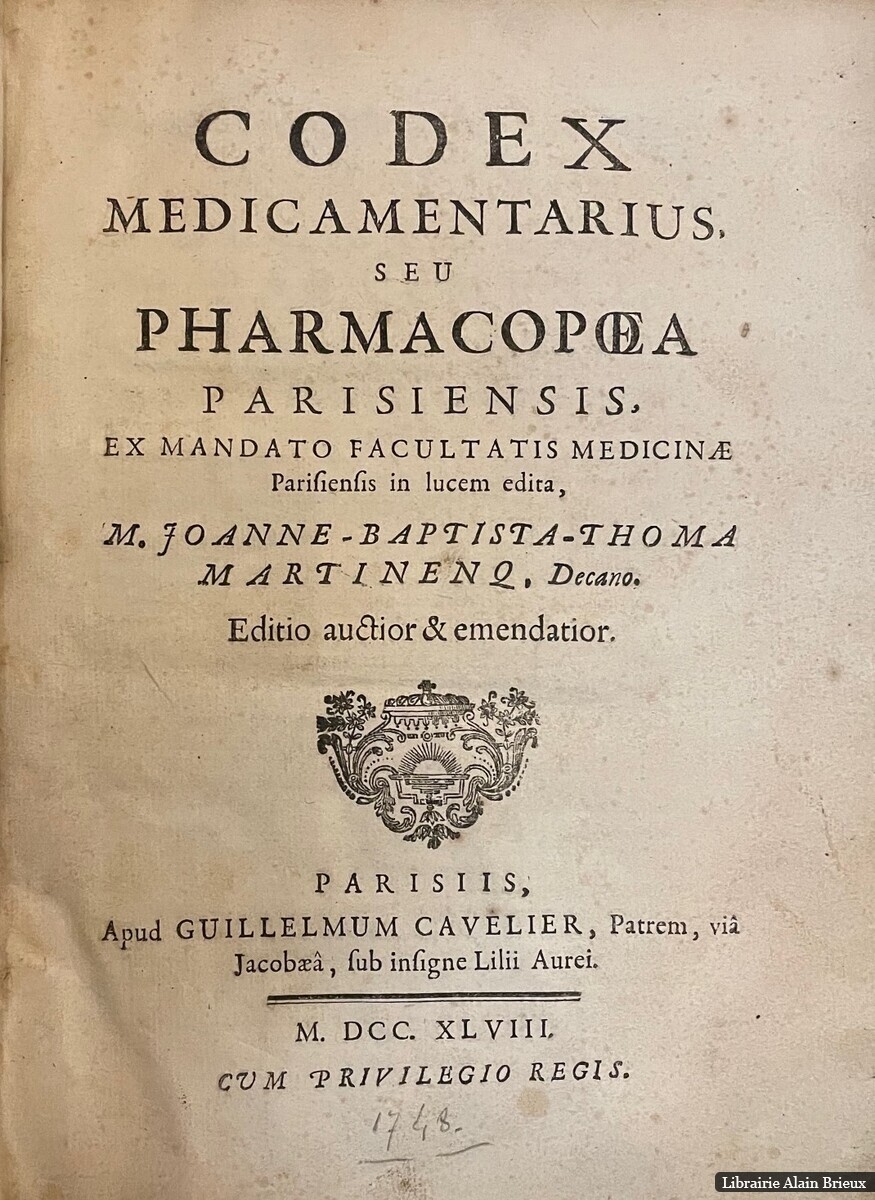
The word is not innocent. From 1818 to 1965, the official French pharmacopoeia was called the Codex: the compendium that said which substances existed, how to prepare them, and at what dose. Only in 1972 did it become the Pharmacopée française. The preface to the 1937 edition gave a superb definition of it: “The Pharmacopoeia records; it does not prophesy” (my translation).
William El Kaim now proposes a codex for enterprise architecture. In AI-Augmented Enterprise Architecture and on eacodex.ai, he describes it as a typed, versioned, machine-usable system connecting intent, policies, decisions, specifications, controls, and feedback. His starting point: when architectural decisions are made continuously, in product teams, platforms, and now agents, a document-based architecture always arrives too late.
Does architecture need a codex? My answer is yes. But not for the reasons one might think.
Yes, because we can no longer dose by hand. When agents act at machine speed, a PDF leaflet reread once a quarter protects no one. The dosage must be readable by those who apply it, humans and machines alike. A codex makes the dose explicit instead of leaving it in the heads of a few architects. It makes it traceable (why this decision, which alternatives were set aside), verifiable (controls rather than intentions), revisable (feedback corrects the prescription), and transmissible (it outlives the departure of those who wrote it).
If I were writing one, I would put the leaflet’s lines up front: a delegation register (what the machine decides, co-decides, never decides), a dependency map with acceptability thresholds, the contraindications, the reassessment dates, and exit plans that have been tested, not just written.
This is where the 1937 formula becomes instructive, by contrast. The pharmacopoeia could afford to record only certainties: it had time. An architecture codex does not. With AI, we decide under uncertainty, on technologies that change faster than editions. An architecture codex must therefore also record its bets, the assumptions on which decisions rest, so we know when they have fallen and the prescription must be rewritten.
But a codex is itself a pharmakon. Plato said it of writing: what we have written down, we end up no longer thinking about. An executable codex can become automated bureaucracy, an illusion of control, a frozen rule applied to a world that has moved on. And there is one line no schema will ever encode: the patient. Culture, power relations, trust between floors.
A codex without a pharmacist is a vending machine. A pharmacist without a codex is a craftsperson who will not scale to the age of agents. We need both.
Technology is an answer. We still need to have asked the right question. With AI, the right question is not “should we go?”. It is: what dose, for whom, for how long, and who decides?
So, in your organisation: does the leaflet exist? Who wrote it, who reads it, and who has the right to rewrite it?
Sources & useful links
Where this started
- Yunik’s Deep Talk, hosted by Rémi Tibi, recorded at VivaTech 2026: “500 M€, an AI company: Crédit Agricole’s plan” (in French), with Aldrick Zappellini, Chief Data Officer of the Crédit Agricole group. Worth hearing in full.
Going further on the pharmakon
- Plato, Phaedrus (the myth of Theuth and Thamus)
- Jacques Derrida, “Plato’s Pharmacy”, in Dissemination (University of Chicago Press, 1981; French original, Seuil, 1972)
- Bernard Stiegler, What Makes Life Worth Living: On Pharmacology (Polity, 2013; French original, Flammarion, 2010)
The architecture codex
- William El Kaim, AI-Augmented Enterprise Architecture (2026) and the AI-Augmented EA Codex website: book, metamodel atlas, public schema, and worked example
The pharmaceutical Codex
- Bruno Bonnemain, “La Pharmacopée de Montpellier de Gay et le Formulaire des médicaments agréables”, Revue d’histoire de la pharmacie, no. 398, 2018 (in French; the 1937 Codex preface is quoted as its epigraph)
Related writing (in French)
- Cartographier vos décisions avant l’IA (Decision Day 1/3)
- Ce que l’IA fait à notre cerveau (Decision Day 2/3)
- La valeur est aux interfaces (Decision Day 3/3)
- Nous venons du chaos, l’IA de la logique (2025): on Amazon
And in your organisation, who sets the dose, and who writes the codex? I read every reaction: in the comments below or at laurence.poussard63@gmail.com.
#AI #Governance #EnterpriseArchitecture #Sovereignty #Pharmakon #ContinuousArchitecture