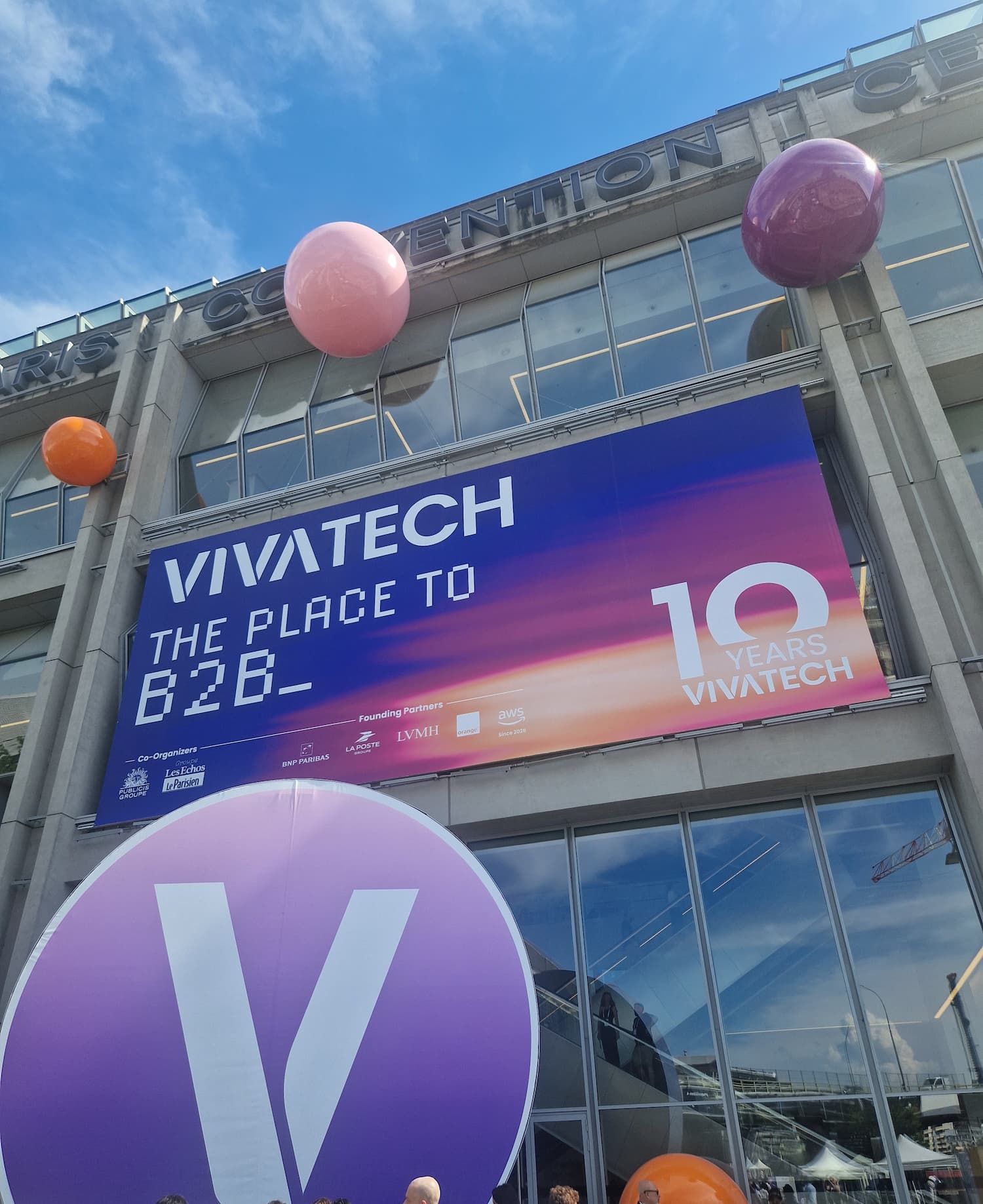
Yes, VivaTech was ten days ago.
No, I didn’t write in the heat of the moment. Everyone else did. The LinkedIn posts went up on Thursday evening — rocket emojis, selfies with robots, “game changer,” “mind blown,” and the traditional blurry photo of a screen displaying something impressive.
I chose not to do that.
Not out of snobbery. Out of intellectual honesty.
Because a show like VivaTech is designed to dazzle you. That’s its function. It’s even its virtue — it makes visible what is still invisible in most organizations. But between what you see and what it means, there is work to be done. Work of distillation, of putting things in tension, of connecting what you observe with what you see elsewhere, in the organizations you support.
That work takes time.
Ten days, to be precise.
Here is what I took away from it — and what the Thursday-evening posts didn’t say.
First shock: medicine
A scan of my retina. Five minutes.
Anomalies identified. No surprise to me — I already knew about them. But it had taken me five years, the right address, the right network, the right persistence to obtain that diagnosis.
Five years versus five minutes.
We’ve heard a great deal about AI in healthcare. Far too much, often for nothing. Medical copilots that ignore the patient’s emotional context. Health-data platforms blocked by regulations no one has genuinely translated into operational constraints. Projects put on hold “while we secure things” — which, in healthcare, sometimes means years.
But there, in front of that retinal scanner, I wasn’t thinking about the technology.
I was thinking about the people who don’t have my address book. Those who don’t have five years to wait. Those for whom “finding the right specialist” is a matter of geographic and social luck as much as medical need.
This isn’t a question of technology. It’s a question of access.
And access is not a data scientist’s problem. It’s a matter of governance, of distribution, of political choices about what we decide to fund, to deploy, and for whom, as a priority. Choices made — or not made — in rooms where tech evangelists are generally not invited.
Who decides how this retinal imaging gets deployed? At what pace? Across which territories? Funded how, and reimbursed by whom?
Those questions weren’t on the stands.
Second shock: the perfume
I told stories from my life. Emotions. Scents that had marked me. And they made a perfume.
It smells wonderful. It resembles me 100%.
I know exactly what happened: a model transformed my accounts into semantic representations, projected them into a space of olfactory parameters, and produced a formulation. Nothing magical. Very sophisticated calculation.
But the experience itself was something else.
It reminded me of something I’ve been writing for a long time: AI does not understand — it correlates. And sometimes the correlation reaches an accuracy so close to comprehension that you can no longer see the difference.
The difference isn’t visible in the demo. It shows up in the edge cases — the patient whose symptoms fit no known pattern, the customer whose story contains a cultural ambivalence the model never learned to decode, the organization whose real problem is the inverse of what it states.
What the perfume confirmed for me was not the power of AI.
It was the power of the staging of AI.
VivaTech is the world’s largest theatre for that. And this is not a criticism — it’s a diagnosis. A theatre can tell profound truths. As long as you know you are in a theatre.
The official tagline of this edition was, however, “Artificial Intelligence: impact, not illusion.” The intention was commendable. But you don’t escape illusion by declaring it on a banner. You escape it by asking the questions the staging conceals.
What else I saw, which moved through me differently
An augmented-reality headset. Virtual flowers at my feet. I bent down to gather them.
I smelled the flowers.
That moment had nothing of a technological demonstration about it. It had something of a promise — the kind of promise that forces you to think seriously about what you do with it.
I was thinking of people who have lost their sight. Of camera glasses that describe what they see, that read signs, that anticipate obstacles, that let you “cross” a landscape through words when the eyes can no longer do it. I was thinking of people who will walk again thanks to exoskeletons, of diagnoses caught earlier, of diseases intercepted before they become irreversible.
The promise is real. Deeply human, even.
But the promise and the trajectory of access are two distinct things. One is shown in five minutes at a trade show. The other is built — or not — in budget trade-offs, reimbursement negotiations, prioritization choices that no one puts on display under the VivaTech lights.
This is not technophobia. It’s the most concrete question there is: who benefits from human augmentation, and by what rules?
What I heard all day — and what troubled me
Sovereignty. Security. Data. Compliance. Inclusion.
In every corridor, on every stage.
And that’s where something troubled me — not because these words were present, but because they were floating. Declarative. Rhetorical. They served as moral cover for demos that, ten metres away, cheerfully embedded biometric processing, behavioural inference, models trained who-knows-where on who-knows-what.
Sovereignty is not a buzzword you slip into a conference slide. It’s an architecture. A concrete decision about where the data lives, who accesses it, under which jurisdiction, with what mechanisms of revocation and audit.
Declaring sovereignty without architecting it is exactly like declaring digital transformation without touching the production systems.
We’ve all lived through that. For fifteen years. We know how it ends.
The observation that worried me most — and was the least commented on
Countries we still called “developing” ten years ago are now outpacing us on certain AI uses. Not on all. But on entire swaths — deployment at scale, cost of transformation, speed of adoption.
How did they manage without the resources we believe indispensable?
They worked on their data. Streamlined their processes. Defined clear priorities and stuck to them. Built in an almost military fashion — without governance committees that drag on for six months, without legacy that paralyzes, without twenty years of IT sedimentation to carry.
This isn’t “constraint breeds creativity.” It’s a form of structural agility that abundance — and accumulated complexity — has denied us.
They had no technical debt. They also had no temptation to keep everything, interconnect everything, maintain everything “just in case.” They built from zero, which is a curse in the classical economy, and a brutal advantage in the data economy.
France — and Europe — do not have an intelligence problem. They have an execution problem. That’s not the same problem. And it’s infinitely harder to solve. Because you can fund intelligence. You cannot buy the ability to simplify what you spent thirty years complicating, nor the political will to do so.
The real question is not: are we behind? It is: what do we choose to fight for — and with what method?
What VivaTech 2026 really taught me
Not that the future is here. I knew that.
Not that AI is powerful. That too.
What I saw, and what it took me ten days to formulate properly, is that the real divide is not between optimists and pessimists on AI. It’s not between early adopters and skeptics. It’s between those who ask the right questions — about governance, about access, about the values encoded in systems, about who holds the wheel — and those who settle for watching the demo.
At a show like VivaTech, everyone shows what AI can do.
The demonstration is spectacular. Sometimes overwhelming. Often sincere.
But no one shows who decided it should work this way. Who defined the training criteria. Which values were encoded, by whom, under what mandate. Which organization gave up what so that this demo could exist.
Those questions are not technical. Nor are they philosophical in the abstract sense of the word.
They are architectural — in the deepest sense of the word. Architecture is what makes visible the choices we made, and the ones we avoided. It’s what turns an intention into an operational constraint, a declared value into a verifiable rule.
As long as we treat VivaTech as a fair of wonder rather than a mirror of our collective trade-offs, we will keep coming back with blurry photos of impressive screens — and unasked questions that will do damage later.
I’d rather ask them now.
Your reactions, disagreements, and additional information are welcome. Write to me at laurence.poussard63@gmail.com or leave a comment.