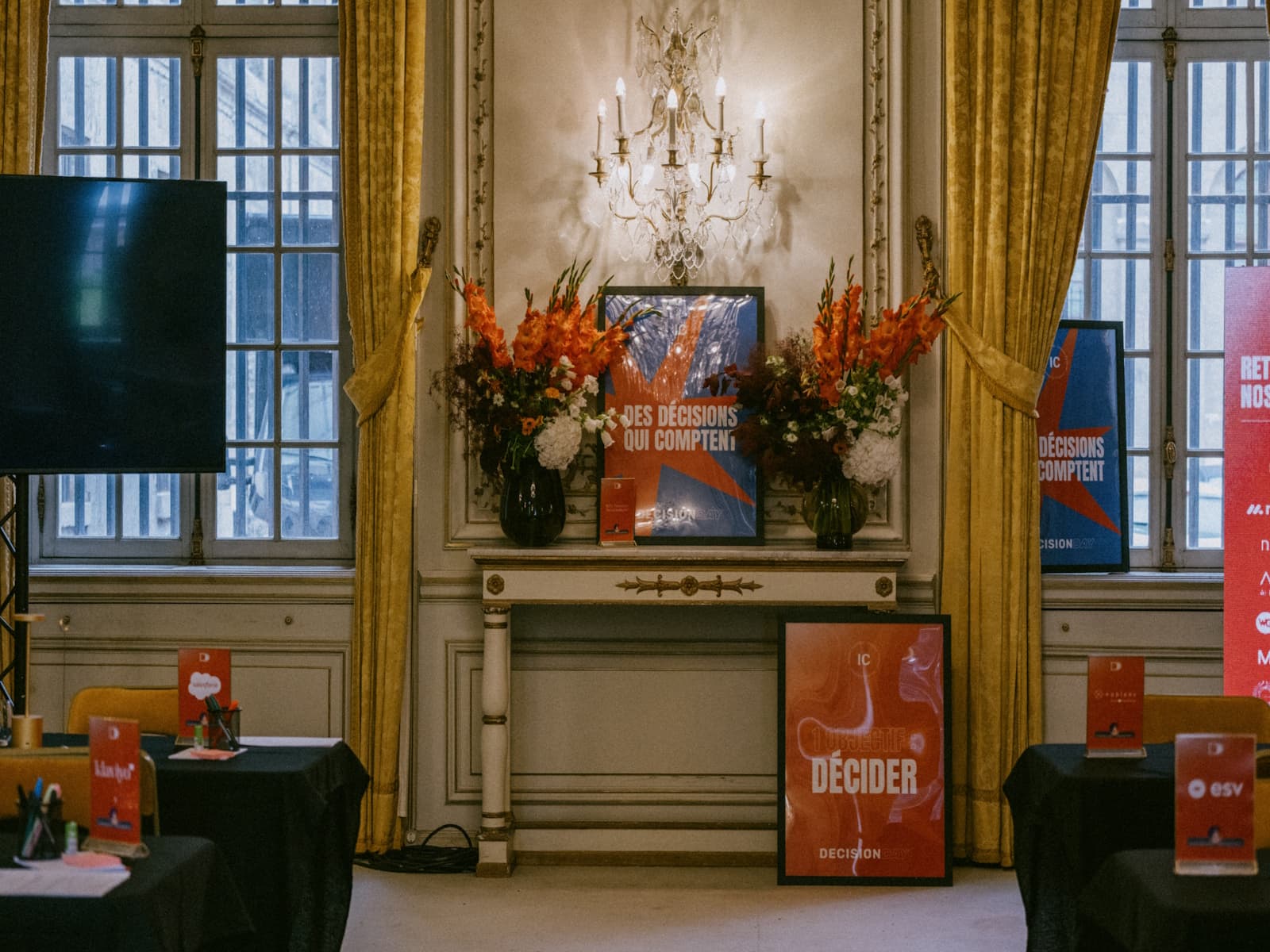
Decision Day 2026 series — Article 1/3
In short
- Before choosing a model or a budget, the real question is: which decisions do we delegate, to whom, and with what possibility of taking back control?
- Three levels structure governance: full delegation, co-decision, exclusion.
- Mapping your decisions is the prerequisite no one wants to fund — without it, AI amplifies the existing disorder.
There is a question almost no organisation asks before launching its AI programme.
Not “which model to choose”. Not “what budget to allocate”. Not “which team to build”.
The question is more fundamental — and more uncomfortable: which decisions are we prepared to delegate, to whom, under what conditions, and with what possibility of taking back control?
Without an answer to this question, everything else — the technical stack, the use cases, the roadmaps — rests on sand.
The bias of apparent complexity
When an organisation approaches its AI transformation, it almost always starts with the technology. That’s understandable: technology is visible, comparable, purchasable. You can run a benchmark, consult a Gartner report, choose a provider. It gives the illusion of mastery because it can be measured.
What we don’t measure — what we don’t structure — is the decision space in which this technology will operate.
And that is where, in reality, the essential plays out.
This is not a consultant’s intuition. It’s what Decision Day 2026 brought to light in a convergent way, through speakers as different as General Loïc Mizon, military governor of Paris, Guillaume Lasconjarias, director of studies and research at the IHEDN, and Vincent Luciani, co-founder of Artefact. Three worlds — defence, strategic research, the digital enterprise — for one shared conviction: without a strategic plan, without defined processes, without a clear target, AI will not produce value. It will amplify the existing disorder.
Three levels. One map. One prerequisite.
The framework proposed that day is disarmingly clear. It distinguishes three types of decision in the face of AI:
Level 1: full delegation. These are repeatable decisions, bounded by clear rules, for which the context is stable and the evaluation criteria are defined. AI decides alone — and that’s legitimate, provided the rules have been explicitly set by humans who take responsibility for them.
Level 2: co-decision. AI informs, proposes, contextualises. The human decides. This is the zone of active cooperation — the one that demands the most organisational maturity, because it assumes a calibrated trust in what AI produces, neither blind nor paralysing.
Level 3: exclusion. There are decisions that do not belong to a machine. In Europe, judicial decisions are the most structuring example: one person must judge another while looking them in the eye. This is not a romantic posture — it’s a principle of legal and moral responsibility that our civilisational framework took centuries to build.
This three-level framework is not a compliance tool. It’s a governance tool. And it can only work on one condition: that the mapping was done before deployment, not after.
What the absence of a map reveals
Most organisations deploy AI in the reverse order. They choose the technology, identify use cases, launch pilots — then discover, the moment the agents actually act on their systems, that they never decided what those agents were allowed to do.
This is not a cybersecurity problem. It’s a problem of decision architecture.
My book Nous venons du chaos, l’IA de la logique already posed the question: “Who decides which use cases to develop? By what criteria? And above all, what do we do when a business opportunity collides with a fundamental value? These trade-offs must be prepared, not improvised.”
That day confirmed it by other paths. As General Mizon noted, with the precision proper to the military world, without a process to prevent sideration, AI’s speed does not produce better decisions — it produces faster decisions in a strategic vacuum. Execution speed without a delegation framework is not a performance. It’s a systemic risk.
The method as a mirror
The day’s War Room workshops, run on the IHEDN method, illustrated this point operationally. The method starts from a simple principle: before evaluating strategies, you define the objective. Before choosing a strategy, you test it against scenarios. And you retain the one that best meets the objective — having clearly identified what you are giving up.
To choose is to give up. To give up is to decide. The bad decision is to make none.
This mantra applies word for word to AI governance. Organisations that don’t map their decisions aren’t choosing — they’re submitting. And they submit twice: first to the unanticipated effects of the agents they’ve deployed, then to the cost of taking back control when the consequences become visible.
What this means concretely
Mapping your decisions before deploying AI means answering four questions that most AI roadmaps ignore:
1. Which decisions do we make today — and which are already, de facto, delegated to systems without anyone having decided it? Shadow AI isn’t only a security problem. It’s the sign that the map doesn’t exist.
2. What are the criteria for moving a decision from level 2 to level 1? In other words: what trust, measured how, over what duration, validates full delegation?
3. Who is institutionally legitimate to hold the line between delegation and human decision? This is not a technical question. It’s a question of organisational governance — and the answer cannot be “the IT department” or “the executive committee” by default.
4. How do we document delegation decisions so that they remain reversible? In a world where models evolve, where contexts change, where regulations become more precise, a delegation granted today must be revisable tomorrow. Without documentation, no reversibility. Without reversibility, no serious governance.
The prerequisite no one wants to fund
There is a painful irony in the current situation. Organisations invest massively in AI technology — models, infrastructure, licences, technical training. They invest very little in what conditions the return on that investment: the clarity of their decision framework, the quality of their processes, the preparation of their teams to decide with AI rather than despite it.
This is the paradox that Continuous Architecture seeks precisely to resolve: not by slowing deployment, but by ensuring that what is deployed fits within a coherent, reversible, governed framework — one that teams understand and that decision-makers can own.
Technology is an answer. We still need to have asked the right question.
Next article: What AI does to our capacity to think — and why cognitive sovereignty is the real blind spot of transformation.
Sources & useful links
The event: Decision Day 2026
- Decision Day 2026, held on 5 June 2026 at Les Invalides in Paris — a day of reflection on the governance of decisions in the age of AI.
The speakers cited
- General (Corps commander) Loïc Mizon, military governor of Paris since 1 October 2024. Official biography — French Army
- Guillaume Lasconjarias, director of studies and research at the Institut des Hautes Études de Défense Nationale (IHEDN). IHEDN profile
- Vincent Luciani, co-founder and CEO of Artefact. Official Artefact page
Methods and frameworks drawn on
- IHEDN — Institut des Hautes Études de Défense Nationale, a training and research body on defence and national-security matters, whose “War Room” method is applied to strategic decision-making. ihedn.fr
- Continuous Architecture, an evolutionary architecture practice and a continuous dialogue between strategy and execution. continuous-architecture.org
- Gregor Hohpe, The Software Architect Elevator, O’Reilly Media, 2020.
Related writing
- Nous venons du chaos, l’IA de la logique — Laurence Poussard, 2025 (in French). Available on Amazon
- The enterprise architect, strategist of the real — not an IS builder — a March 2026 article posing the same question from a geopolitical angle. Read the article
- Continuous Architecture Facing the Unpredictable (2026) — full strategic analysis dossier. Consult the dossier
Your reactions, disagreements and additions are welcome. Write to me: contact.
#DecisionDay2026 #AIGovernance #EnterpriseArchitecture #ContinuousArchitecture #AITransformation