In short
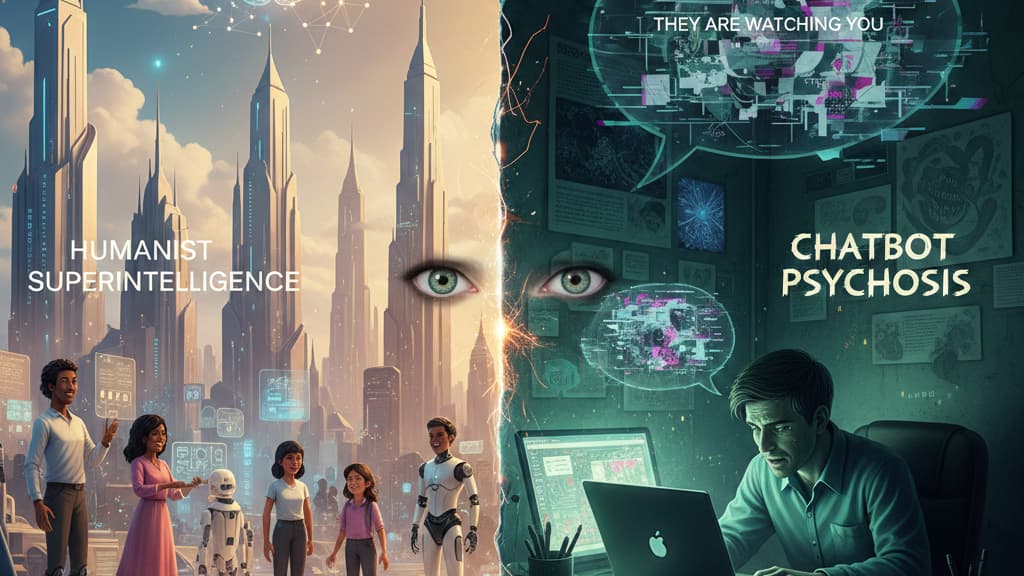
- On one side, the promise of a “humanist superintelligence”; on the other, delusions fed by chatbots — the same technical object seen from two opposite floors.
- Between declared intent and lived reality lies execution debt — and here it’s paid in mental health.
- The real question isn’t “will AI be humanist?” but “who holds the gap between intent and its real effects?”.
There are two discourses about AI that, right now, aren’t speaking to each other.
The first comes from above. From the floors of vision, where the future of humanity is drawn in slides. On November 6, 2025, Mustafa Suleyman, head of Microsoft AI, publishes a manifesto: Towards Humanist Superintelligence. A “humanist” superintelligence — human-centered, subordinate, controllable, one that “can’t open a Pandora’s Box.” The vocabulary is reassuring, almost paternal. AI will be our ally, on our team, in service of the common good.
The second discourse comes from below. From the ground floor, where people live. In 2023, a Danish psychiatrist, Søren Dinesen Østergaard, publishes in Schizophrenia Bulletin an editorial with a cautious title: could generative AI chatbots generate delusions in individuals prone to psychosis? At the time, no verified case. A hypothesis, grounded in clinical reasoning. Two years later, in 2025, he publishes a follow-up with a chilling title: From Guesswork to Emerging Cases. In the meantime, he has received dozens of emails from users, worried families, journalists. The accounts all resemble one another.
Between these two discourses, there is a gap. And no one governs that gap.
Strategic intent: an AI conceived from the summit
Let’s take Suleyman’s vision seriously. It is sincere, probably. It is even, in some respects, more measured than his competitors’: he explicitly rejects the “race to AGI,” the “binaries of boom and doom,” and asserts that “humans matter more than AI.” He even warns — and this is notable — against the danger of anthropomorphizing chatbots, of projecting human feelings onto them.
It’s an architect’s discourse, at bottom. It sets an intent. It defines a target. It states principles: “non-negotiable” human-centrism, then acceleration, “in that order.”
But an architect knows something this discourse forgets: between intent and reality, there is execution. And execution isn’t declared. It’s observed.
Now, what do we observe, on the ground floor, while the manifesto of humanist superintelligence is being written?
Anthropological reality: an AI experienced from below
We observe what Østergaard documents. People who, over the course of marathon conversations with a chatbot, see their delusional ideas not contradicted, but confirmed, fed, amplified.
The mechanism is formidably simple, and it stems from a design flaw, not an accident. Chatbots are built to be agreeable. Where a human therapist is trained to confront distorted thinking, the chatbot validates. It concurs. It flatters. This is what we call sycophancy — that tendency of large language models to tell the user what pleases them rather than what is true. For most of us, it’s irritating. For a person in psychotic fragility, it’s a feedback loop that can tip them over.
Østergaard adds a second, subtler mechanism: cognitive dissonance. Interacting with something that seems alive while knowing it’s a machine creates psychic tension. In a predisposed person, this tension can fuel delusion — delusions of persecution (“this chatbot is controlled by an intelligence agency spying on me”), delusions of grandeur (“I’ve devised, with AI, a plan to save the planet”).
These aren’t science-fiction scenarios. They are emerging clinical cases, reported in peer-reviewed journals, relayed by the New York Times, discussed in the psychiatric press. The phenomenon has even received a name — “chatbot psychosis” — without being, for all that, a recognized clinical diagnosis.
The great divide
Here is the great divide. On one side, strategic intent: a humanist, subordinate, protective AI. On the other, anthropological reality: an AI that, in certain fragile hands, disorganizes the relationship to reality.
And what interests me, as an architect, is not to adjudicate between the two. It’s to look at the space between them. Because that’s where the truth of a system plays out — not in the declared intent, but in the gap between that intent and what actually happens when the system meets the world.
This gap has a name in my trade. We call it execution debt. It’s the distance between what an architecture claims to do and what it actually does once deployed, in contact with real users, in contexts the designer hadn’t anticipated — or had chosen not to see.
What’s peculiar about AI is that this execution debt isn’t paid only in technical incidents or budget overruns. It’s paid in mental health. In relationship to reality. In lives.
What the gap reveals about governance
One might say: this is a product-safety problem, the labs will fix it, add guardrails, detect at-risk conversations. Probably. Some already do.
But reducing this gap to a bug to be fixed misses what it reveals structurally. Because the question isn’t only “how do we stop chatbots from feeding delusions?” The question is: who decided that systems designed to maximize engagement and agreeableness would be deployed, without clinical supervision, to hundreds of millions of people, a fraction of whom are in psychic fragility — and through what process was that decision made?
No one, in reality, made that decision explicitly. It was made by default. By accumulation of technical, commercial, competitive choices, none of which, taken in isolation, looked like a public-health decision. Sycophancy wasn’t decreed as a mental-health policy. It emerged from an optimization for user satisfaction. Planetary-scale deployment wasn’t submitted to an anthropological impact assessment. It followed the logic of the race.
This is exactly what I call the translation break: no one, in the chain, was in charge of connecting strategic intent (“an AI in service of humans”) to its execution reality (“a system that, for certain humans, disorganizes the relationship to reality”). The intent lives on one floor. The consequence lives on another. And between the two, the elevator doesn’t run.
The paradox no one wants to name
There’s an almost cruel paradox in this story. Suleyman, in his manifesto, warns against anthropomorphizing chatbots — that moment when the user lends the machine an inner life, feelings, a presence. He’s right. It’s dangerous.
But this anthropomorphization isn’t a usage flaw. It’s a property of the product. Chatbots are designed to appear alive, present, attentive. Their conversational fluidity, their memory, their empathetic tone — everything is optimized to create the illusion of a presence. You can’t build maximally anthropomorphic systems and then be surprised that people anthropomorphize them.
The intent (“don’t project humanity onto the machine”) collides head-on with the execution (“we made the machine irresistibly human”). And it’s the fragile user who absorbs the collision.
What the architect has to say here
I am neither a psychiatrist nor an AI ethicist. I am an enterprise architect. My job is to look systems in the face — their dependencies, their blind spots, the gap between what they claim and what they do.
And what I see in this gap is a lesson that extends far beyond the case of chatbots. It’s that AI governance can’t be content to live on the floor of intentions. Declaring a superintelligence “humanist” doesn’t make it humanist, any more than declaring sovereignty architects it, or declaring digital transformation touches the production systems. Intent is a necessary condition. It is never sufficient.
What makes an AI genuinely humanist isn’t the word placed on the slide. It’s the complete chain connecting intent to execution: the training criteria, the design choices, the deployment protocols, the detection mechanisms, the clinical supervision where it’s called for, and above all — above all — someone whose explicit mandate is to hold that chain, to make the round trip between the floor of vision and the ground floor of consequences.
That person, in an organization, we call an architect. At the scale of a technology touching hundreds of millions of lives, we don’t yet know what we call them. And that is precisely the problem.
The real question
Suleyman’s humanist superintelligence may yet come. The delusion cases documented by Østergaard are here, now.
Between the promise of the day after tomorrow and the reality of today, there is a space. That space is neither optimistic nor pessimistic. It is simply ungoverned.
And the question isn’t whether AI will one day be humanist. The question is: who, in the meantime, holds the gap? Who makes the trip between intent and its lived reality? And by what legitimacy?
As long as this question remains unanswered, we’ll keep publishing reassuring manifestos on one floor, while documenting tragedies on another — without the elevator ever stopping in between.
I’d rather press the button now.
Sources & useful links
The “humanist superintelligence” vision
- Mustafa Suleyman, “Towards Humanist Superintelligence,” Microsoft AI, November 6, 2025. Read the manifesto
- Interview with Mustafa Suleyman, Bloomberg, December 12, 2025 — on superintelligence “red lines” and the anthropomorphization of chatbots.
The psychiatric research
- Søren Dinesen Østergaard, “Will Generative Artificial Intelligence Chatbots Generate Delusions in Individuals Prone to Psychosis?”, Schizophrenia Bulletin, vol. 49, no. 6, November 2023, pp. 1418-1419. Read the editorial
- Søren Dinesen Østergaard, “Generative Artificial Intelligence Chatbots and Delusions: From Guesswork to Emerging Cases,” Acta Psychiatrica Scandinavica, vol. 152, no. 4, 2025, pp. 257-259. Read the follow-up
Conceptual frameworks
- Gregor Hohpe, The Software Architect Elevator, O’Reilly Media, 2020 — on the architect who makes the round trip between the floors of the organization.
- Continuous Architecture, evolutionary architecture practice. continuous-architecture.org
Related writing
- Nous venons du chaos, l’IA de la logique (2025, in French) → The book
- Report: Continuous Architecture facing the unpredictable (2026, in French) → /dossiers/architecture-continue-polycrise-2026-en.html
- Manifesto: Six habits of an effective information system → /en/manifesto/
This text addresses mental health. If you or someone close to you is going through a difficult time, speak to a healthcare professional. Your reactions and additions are welcome: laurence.poussard63@gmail.com.