A woman sitting cross-legged on a terrace facing mountains at sunset, a notebook and a cup beside her, in conversation with a luminous figure representing AI

What if AI gave the mind back to what matters?

It wasn’t at a conference on AI that I heard the truest sentence about AI in recent weeks. It was on a podcast about rest, listening to a coach talk about ten days on retreat in the Jura mountains. She wasn’t talking about models, or productivity, or transformation. She was talking about everything that doing nothing gives us: rest, silence, the ideas that surface when the mind is finally allowed to settle. And along the way, in two sentences, she said what I’ve been defending for a long time about the place of AI. ...
September 26, 2026 · 16 min · Laurence Poussard
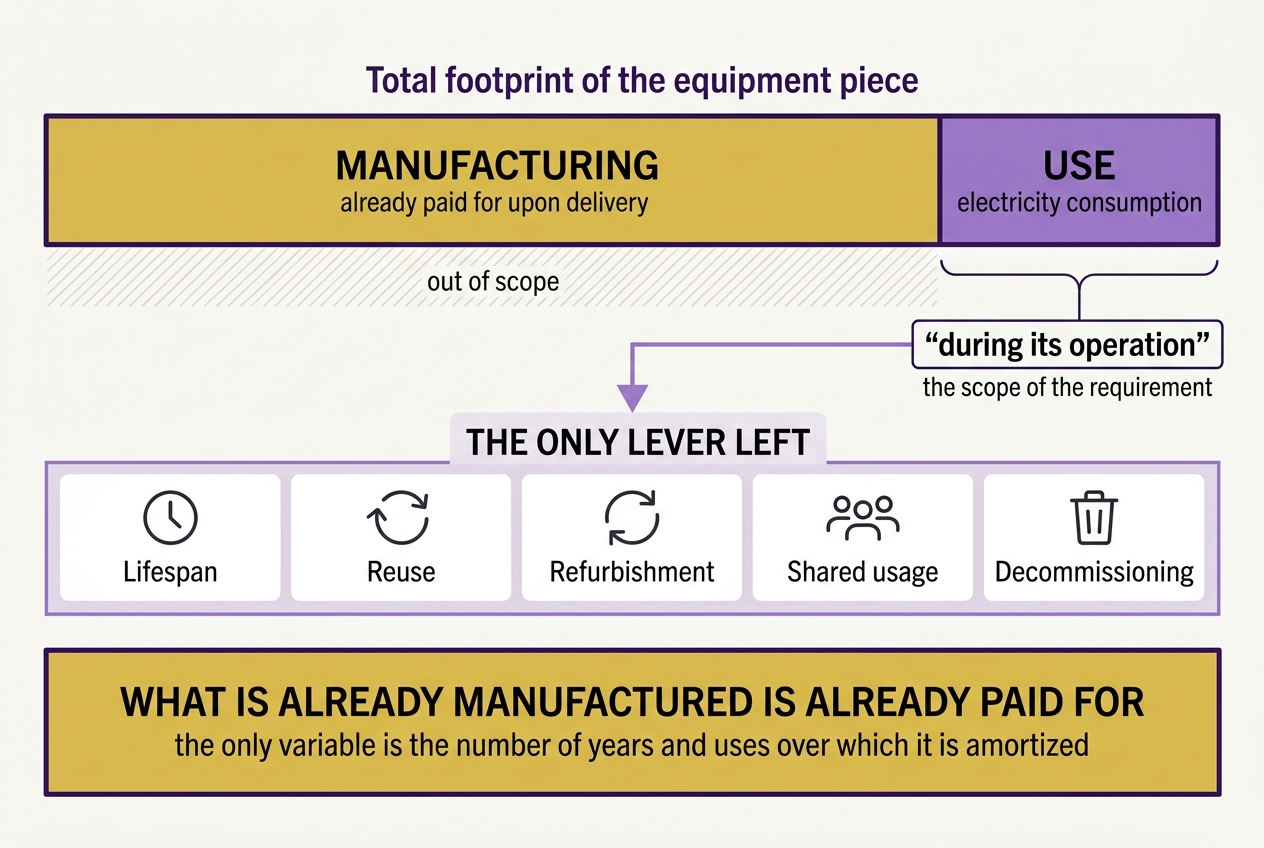
Bar showing the footprint of a device, split into a large manufacturing segment and a small usage segment; the requirement covers only the usage segment, while five levers — lifespan, reuse, refurbishment, pooling, decommissioning — apply to the manufacturing segment

What is already manufactured is already paid for

Green IT series — Article 4/4 Two years ago, as part of a CSRD compliance programme, I was handed a non-functional requirement. It came down to a single sentence: the solution must make it possible to have indicators for assessing its environmental impact during operation. An environmental requirement, written in black and white, in a document that binds design. On paper, that is a win. In short Three words are enough to empty an environmental requirement of its force: during operation excludes manufacturing, which is to say the heaviest item of all. What is already manufactured is already paid for. The only remaining variable is lifespan, reuse and decommissioning — which is where the circular economy of IT becomes an architecture subject. Regulatory pressure has receded; the footprint has not. An organisation that has not prepared the ground will find itself at exactly the same point when the demand returns. ⎙ Imprimer / Télécharger en PDF Three words that empty a requirement Let us read it again, because everything turns on how it is worded. ...

September 17, 2026 · 11 min · Laurence Poussard
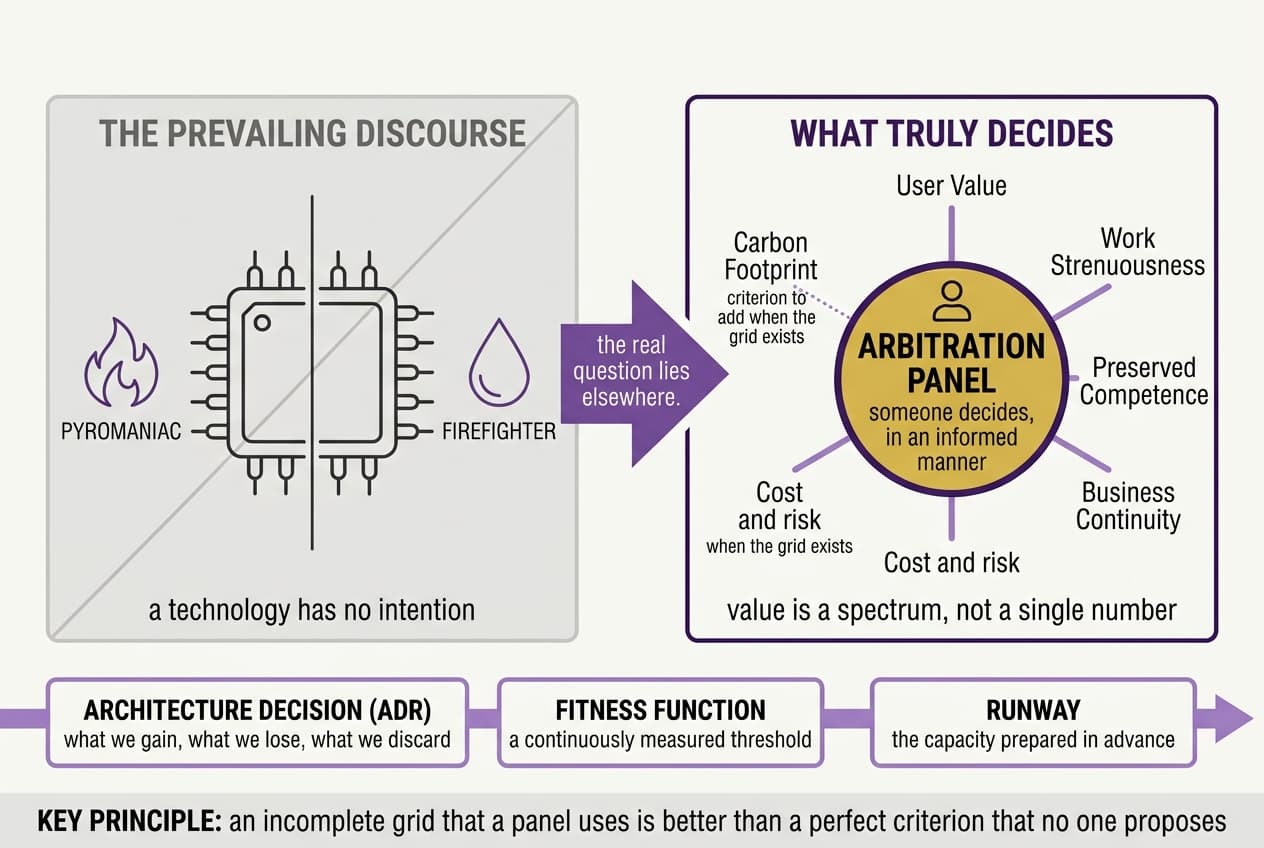
Diagram contrasting the ambient narrative of AI as firefighter and arsonist, set aside, with a decision arbitration body surrounded by several axes of value including a dotted carbon axis, above a band showing architecture decision records, fitness functions and runways

AI is not the arsonist

Green IT series — Article 3/4 I have a weather station at home. It gives me temperature, pressure, humidity and the variations of the last few hours. With that, I have a fair idea of tomorrow’s weather — and if I am unsure, a dozen outlets publish the forecast for free. And yet the question of tomorrow’s weather is put to generative AI thousands of times a day. Systems which must analyse everything before answering. ...

September 9, 2026 · 15 min · Laurence Poussard
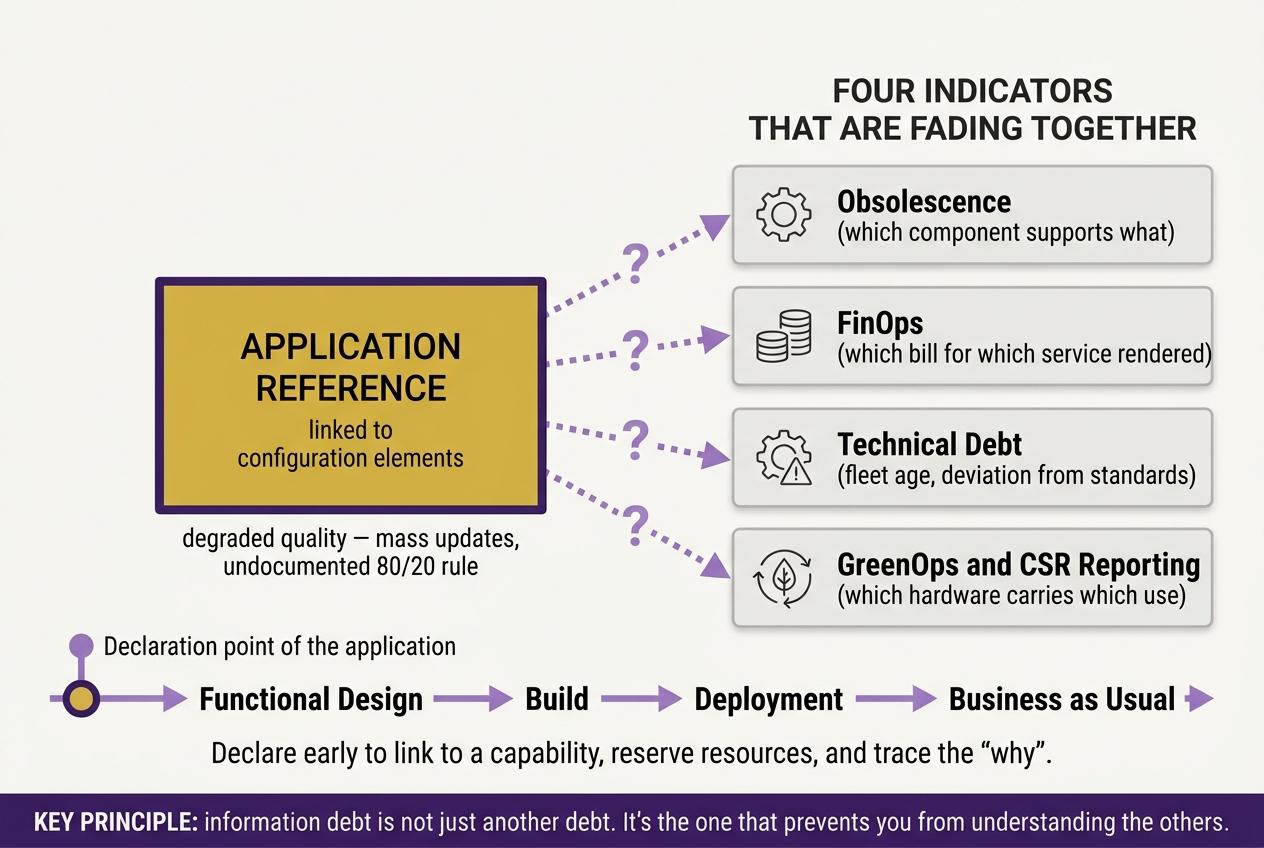
The application reference linked to configuration elements, and the four indicators — obsolescence, FinOps, technical debt, GreenOps and CSR reporting — that fade together when it degrades

Technical debt is carbon debt

Green IT series — Article 2/4 One day, an IT department is asked to measure the carbon footprint of its application portfolio. The request is legitimate, the sponsor is solid, the deadline is regulatory. And that is when it emerges that the number is out of reach. Not because the method is missing — because the data it would have to be applied to was bulk-updated some years ago, according to a rule nobody remembers the content of. ...

September 7, 2026 · 13 min · Laurence Poussard
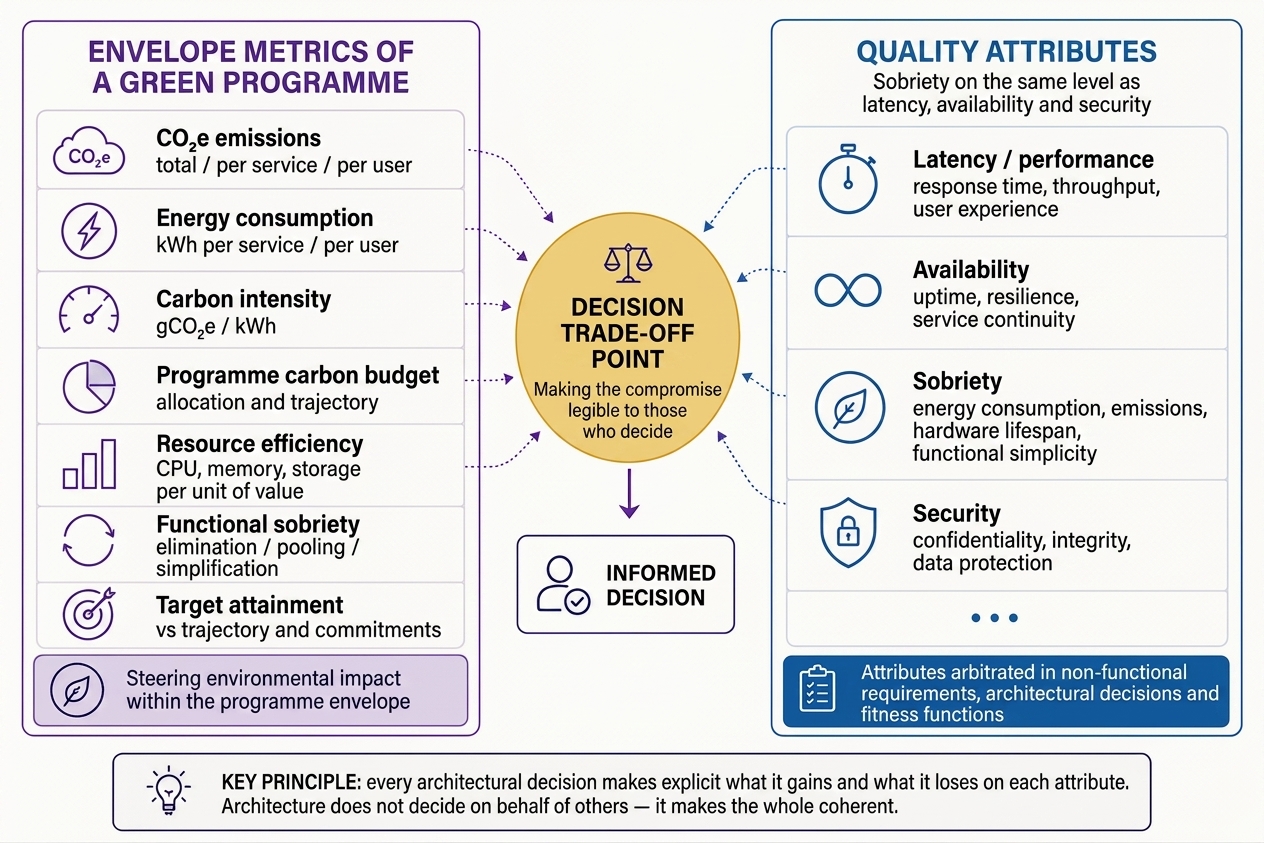
Two-column diagram: on the left the envelope metrics of a green programme, on the right quality attributes including sobriety alongside latency, availability and security; at the centre a decision trade-off point connecting both and leading to an informed decision

Everyone optimises, no one arbitrates

Green IT series — Article 1/4 A perfectly cooled datacentre, running workloads no one consults any more, will post an excellent PUE. That is the whole problem. And it is only the visible version of a much wider paradox. In short PUE measures the efficiency of the envelope, never the usefulness of the computation — and the same illusion plays out at organisational scale, where a green programme coexists with projects that have no reason to ever cross its path. Enterprise architecture is not there to constrain choices or arbitrate between visions. It is there to make the whole coherent — provided it sits in the right place, with the right levers. Sobriety and the circular economy of IT are not programmes running alongside the value stream. They are quality attributes within the value stream. ⎙ Imprimer / Télécharger en PDF A flawless indicator for an absurd system Let us start with the tool, since the tool is what gets brandished. ...

September 4, 2026 · 14 min · Laurence Poussard
Role Schizophrenia

Conway's Law: When HR Titles Fragment the System Before the Code Does

In short Jack of all trades, master of none: that hire has never delivered Architecture gets decided the moment the org chart and job descriptions are written In the age of AI, the mistake costs more: the real scarcity isn’t model mastery, it’s knowledge of the business being assisted ⎙ Imprimer / Télécharger en PDF Cloud architect. AI architect. DevOps architect. Integration architect. Tomorrow, no doubt, agentic architect. Every technology wave demands its own totem, and the organization complies — a role, a job description, a line in the org chart. ...

July 31, 2026 · 10 min · Laurence Poussard
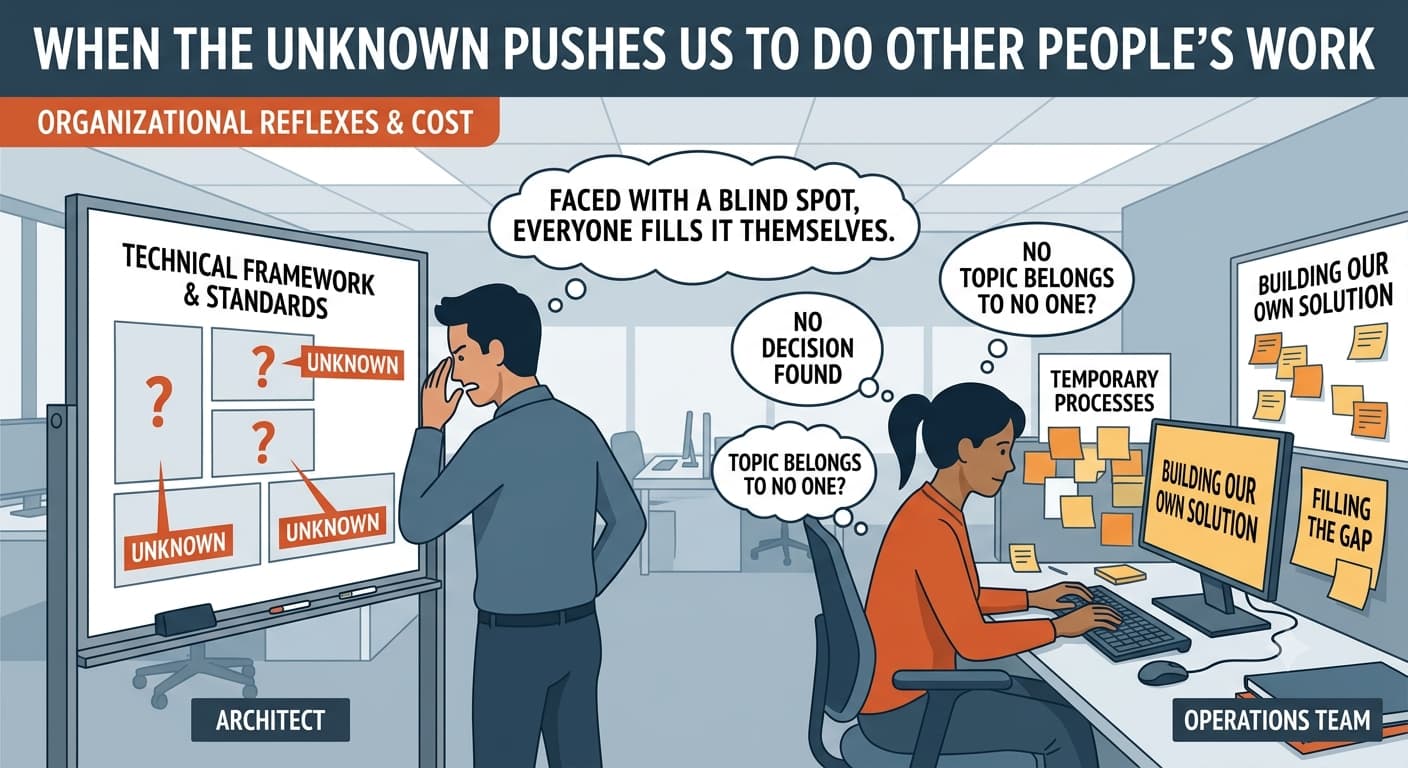
When the Unknown Pushes Us to Do Other People's Work

When the Unknown Pushes Us to Do Other People's Work

Faced with an organizational blind spot, everyone tends to fill it themselves — and that reflex comes with a measurable price. In short Role ambiguity is, per the research, the costliest workplace stressor there is Escalating a need for clarity is healthy; bypassing someone else’s role to decide in their place isn’t Changing roles is legitimate — quietly exercising one you never took on isn’t ⎙ Imprimer / Télécharger en PDF The Perception Trap When the Unknown Pushes Us to Do Other People’s Work There’s a behavior found in almost every company, regardless of size or industry. ...

July 31, 2026 · 9 min · Laurence Poussard
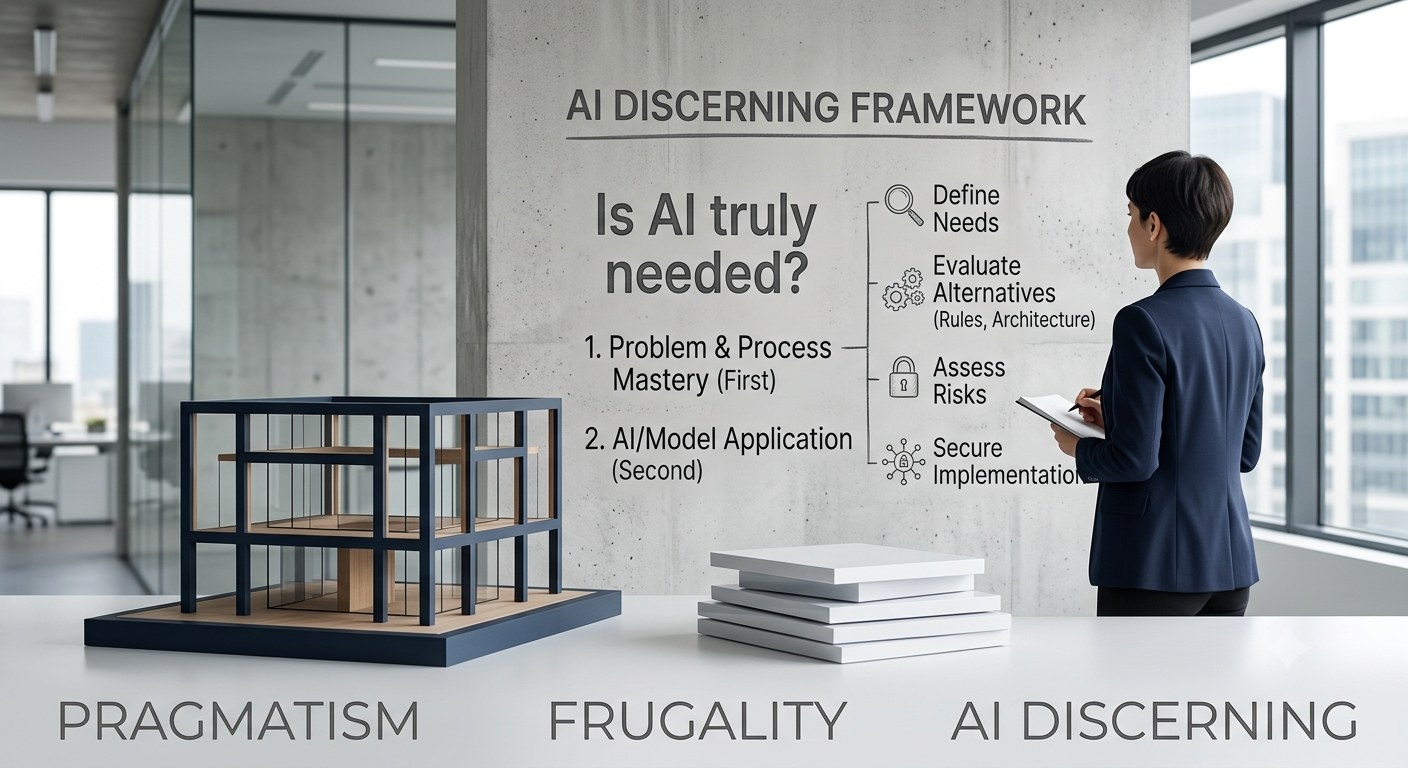
An architecture model next to a diagram titled AI Discerning Framework, with the words pragmatism, frugality and AI discerning

AI Maximalism Is Not a Sign of Boldness

In short Pushing AI to its limits is not a sign of audacity: it is often a lack of judgment disguised as courage. True audacity lies in deliberate frugality—choosing where AI creates value, and where it does not. Pragmatism is not lukewarmness: it is the most demanding form of technological discernment. ⎙ Imprimer / Télécharger en PDF There’s a reflex I see resurface in almost every engagement I work on, in different guises but with the same root: the conviction that AI is needed, everywhere, right now, or you’ll fall behind. This reflex has a name, and I won’t shy away from it: it’s maximalism. And like every form of maximalism, it dresses itself up as strategic necessity to dodge the only question that matters: do we actually need this? ...

July 27, 2026 · 7 min · Laurence Poussard
Vivatech - 10th edition - 2026

VivaTech 2026: what I saw struck me less than what it revealed

Yes, VivaTech was ten days ago. No, I didn’t write in the heat of the moment. Everyone else did. The LinkedIn posts went up on Thursday evening — rocket emojis, selfies with robots, “game changer,” “mind blown,” and the traditional blurry photo of a screen displaying something impressive. I chose not to do that. Not out of snobbery. Out of intellectual honesty. Because a show like VivaTech is designed to dazzle you. That’s its function. It’s even its virtue — it makes visible what is still invisible in most organizations. But between what you see and what it means, there is work to be done. Work of distillation, of putting things in tension, of connecting what you observe with what you see elsewhere, in the organizations you support. ...

June 30, 2026 · 7 min · Laurence Poussard

When AI plays at scaring itself — and at making us believe

In short AI doomerism has the structure of a religious movement — but what matters isn’t the discourse, it’s the capture it performs. The very actors brandishing existential risk are building the AI and concentrating decision-making power in a few private hands. The real fault line isn’t fear versus optimism, but power versus democratic governance. ⎙ Imprimer / Télécharger en PDF In response to Nirit Weiss-Blatt’s article, “First They Built a Secular Apocalypse Belief System. Now They Want Religious Authority.” ...

June 3, 2026 · 8 min · Laurence Poussard